Introduction: Historical Contextualization of Yasujiro Ozu
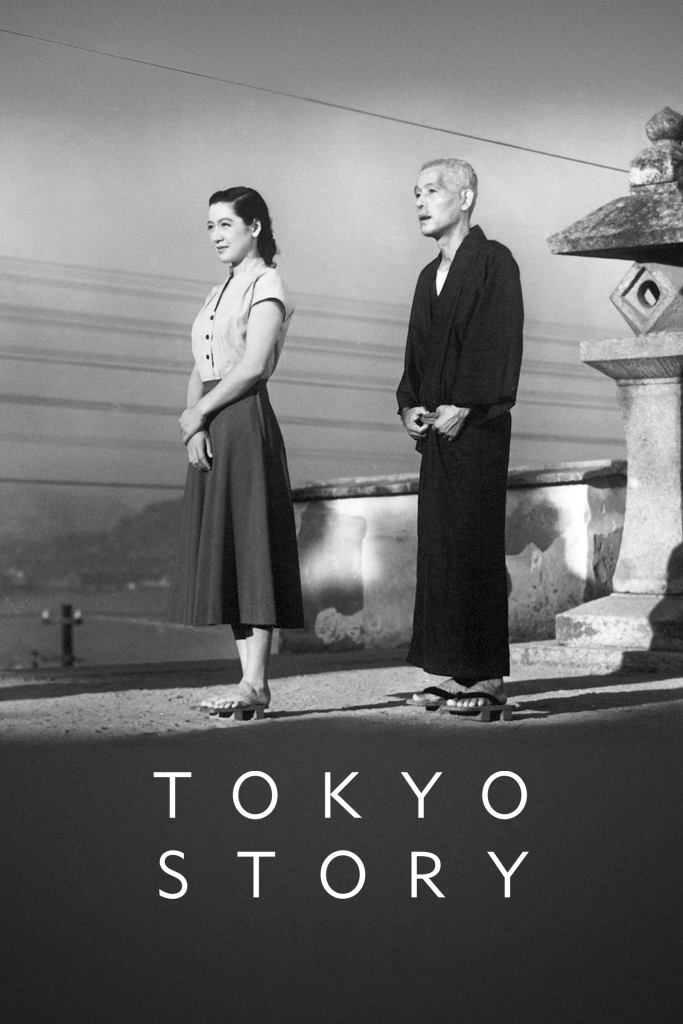
The director discussed in this essay will be Yasujiro Ozu, one of the key masters of Japanese cinema, cited alongside that of Akira Kurosawa and Mizoguchi Kenji. Ozu is the celebrated director of the Shochiku Studios in Tokyo. The national and cultural esteem afforded Ozu is highlighted by the Shochiku Studios inauguration of his 110th birthday in 2013, by restoring four of his colour films, among them An Autumn Afternoon played at Cannes and Equinox Flower at Venice International film festival [ONLINE: 2013, The Japan Times]. Indeed it was at the Shochiku he met his scriptwriter Noda Kogo and his cinematographer, Shigehara Hideo, key figures in his establishment of the formal modernist style of ‘Kamata’ that defined Ozu’s aesthetics: ‘All were involved in forging the new Kamata style’ (p54, Richie, 2012).
David Bordwell identified Ozu as belonging to what he termed the ‘piecemeal’ style that he describes as one piece of information per shot. The style is one where shot lengths are short, and are ‘comprised of neat, static shots, was associated with gendaigeki and derived mainly from Lubitsch’ [ONLINE, Bordwell]. Whereas Mizoguchi’s ‘pictorialist’ style associated with shimpa and influenced by Josef von Sternberg, with complex long take sequences. ‘I portray the extraordinary in a realistic way. Ozu portrays the ordinary in a realistic way- which is even more difficult’ (p130 Richie, 2012), Mizoguchi said in reference to Ozu- and he primarily disclosed this realism through the minutely observed details of everyday middle class domestic life.
Ozu’s Representation of traditional Japanese family Life
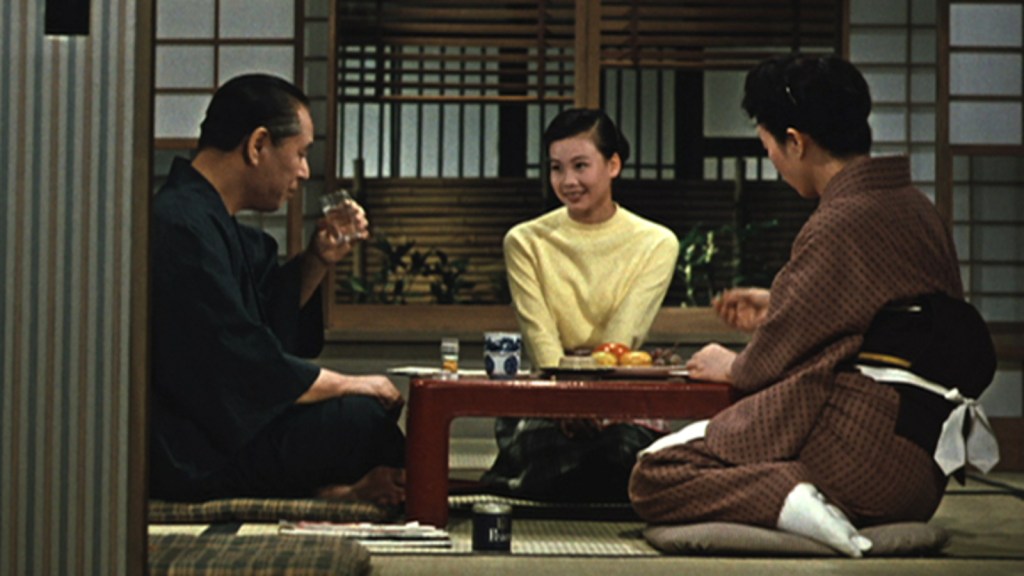
Ozu representation of the traditional family is acutely observed, as is evidenced in the changes that subtly occur from the films of his later period. If we examine his earlier classic of the late forties Late Spring (Ozu, 1949) and compare it to his final work in films such as The End of Summer (Ozu, 1961) or An Autumn Afternoon (Ozu, 1962), we see significant alterations not only in the domestic dynamics of the family but also subtle transformations in its economic structure. Ozu’s focus is on the dissolution of the family unit, specifically in the later films it is the traditional Japanese upper-middle class family, and so ‘Ozu’s films are a kind of home drama’. And according to Richie this extends to what he describes as the ‘foster homes’ of the school and the office. The Ozu character, ‘like the Japanese himself, tends to move among the three: the house, the schoolroom, the office’ (p267, Orr and Taxidou, 2007), and in Asia where the family remains the social unit the ‘dissolution of the family is a catastrophe in Japan…as one’s sense of self depends to an important extent upon those with whom one lives, studies, or works’ (p268, Orr and Taxidou, 2007).
The very first line of Late Spring concerns the recycling of Noriko’s uncle’s trousers and turning them into a pair of shorts. There are other allusions to the financial state of such families in Japan at the time, the so-called ‘bamboo- shoot existence’: her auntie says ‘remember to reinforce the seat’, so they will last longer; there also seems to be a lack of Saki in the household, and it is not so long ago that everyone, including Noriko were ‘spending her holiday’s scrounging for food’, as her father puts it. She is used to going without food, as in the war there were shortages and forced labour. Saki is a luxury, and it wasn’t until 1951 that Japan reached its pre-war food consumption levels.
Above and beyond the financial dimension of domestic Japanese family life were the changes that occurred in the expectations of women. For example Noriko in End of Spring is not married yet, and we are told that she is 24 years old, and after the age of 25 she would become a ‘Christmas cake’ (p158, Takemaru, 2010), an allusion to no one buying cakes after the 25th. Pre-War ethics text books emphasized female ideal of ‘filial piety’ or ‘good wives, wise mothers’- these are taken out of textbooks and a post-war ideal emerges as women were given the right to vote, and granted equality in marriage and divorce, and property rights by the ‘new constitution’. Japans constitution, contained in a small booklet called ‘Bright Life’ was written by American woman Beate Sirota Gordon and includes an ‘equal rights clause’ not included in the US constitution. Ozu observes the erosion of tradition and the generational differences through the Westernized clothes the younger people wear, Noriko stands for much of the journey, she rides a bicycle, she can work, but above all else she can resist marriage and the authoritarian oppression of the traditional Japanese patriarchal family. And yet Ozu shows us that for all the liberation that may have occurred in post-war Japanese culture there is still the censorial presence of a conformist society: and even though she cycled to the beach with her father’s handsome young assistant, she refuses to attend the a music show with him for reasons of propriety, and instead Ozu shows us a an empty seat next to the young man.
But ultimately Noriko relents, releasing the inevitability of transition and change in life, and agrees to marriage. ‘Be happy, and be a good wife’ she is told by her father at end of the film as she submits to the duty of marriage. In typical Ozu style we do not see the marriage of Noriko; instead we have an ellipsis to the time after the marriage ceremony. Noriko’s father, after drinking in a bar with his daughter’s friend Aya, returns home alone, he sits down peeling an apple, the peeled skin coils and falls to the floor, his head bows as though in resignation- a lonely figure- Ozu then cuts to the sea at evening as the final shot of Late Spring, alluding to the ebb and flow of the tide coming in is just like life inevitable and constant.
Ozu’s Later Colour Period
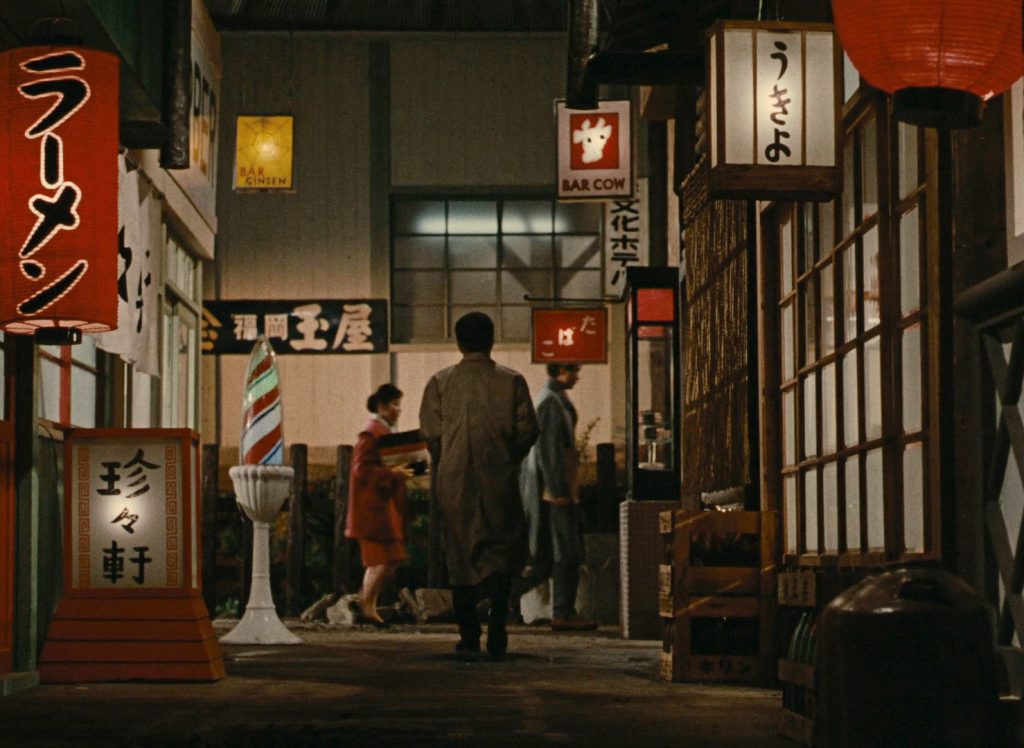
The later films such as The End of Summer we see signs of conspicuous consumption from ordinary Japanese citizens in everyday life, such as when a girl in a bar at the beginning of the film takes out a luxurious makeup mirror, the man at the bar says that it is an ‘expensive gift’, but she replies ‘I bought it myself’. So here we see that from the late forties to the early sixties the ‘Japanese miracle’ has increased prosperity and people in general are better off; but at the same time, the young woman’s insistence on her buying her own expensive gifts illustrate her independence as a woman. How then these factors influence the shape of traditional family life in Ozu’s later films? Again the theme is young women pressurised into the married life of the ‘good wife, wise mother’ role. Men, in what is largely a conservative society, are still the power-bearers, in positions of status, such as the office, much like a modern form of feudalism. And feudalism is echoed in the series of ‘arranged introductions’, often seeking ‘good families’ for their daughters, mirroring the medieval ‘dowry’- Ozu asserted that today’s young people, despite generational differences and conflicts, will eventually behave just like their parents, for ‘feudalism hasn’t really disappeared from the Japanese heart’ (p122, Richie, 2012).
And these empty still life shots are more abstract and increasingly empty both in End of Summer and Autumn Afternoon. Just like in Late Spring when Noriko cycles to the beach we see Coca-Cola signs, this time in an office corridor, emblematic of the cultural dominance of America, with Japan subject to pronounced Americanization. Apart from the signs of consumption and affluence everywhere compared to the late 40s, there is more neon advertising, Peace ‘brand’ cigarettes, cakes, a seeming abundance of Saki. In An Autumn Afternoon we see a fridge, televisions, baseball, and apparently more leisure time, certainly among the middle classes that Ozu is primarily interested in. The American military occupation is not evidenced in Ozu’s films of this period, at a time in the early sixties when there were thousands protesting on the streets to the Japan-American security treaty. And yet in The End of Summer we have a rare glimpse of an American, who offers the old man’s daughter ‘exotic gifts’, one of them a luxury item like shark eggs.
But essentially Ozu is not really interesting in plot or huge dramas, as evidence in his extensive utilization of ellipses and punctuating actions with ‘empty shots’. Ozu’s strategies are rooted in elements of Japanese aesthetic tradition- the de-emphasis of drama and the elision of plot elements in theatrical works, the emphasis on mood and tone instead of story in literature. An Ozu film has little extraneous events, that often frustrate or negates the simple ‘cause-effect chain that is a function of Western…individualism, and bourgeois capitalism’ (p20, Eleftheriotis and Needham, 2006). And for many, including David Bordwell, Ozu offers an alternative to Hollywood mainstream cinema. The purpose of plot elision for Ozu is the contemplation of the perennial truth that ‘we are rarely together, we are usually alone’ (p121, Eleftheriotis and Needham, 2006).
Ozu’s Compositional Stylistics
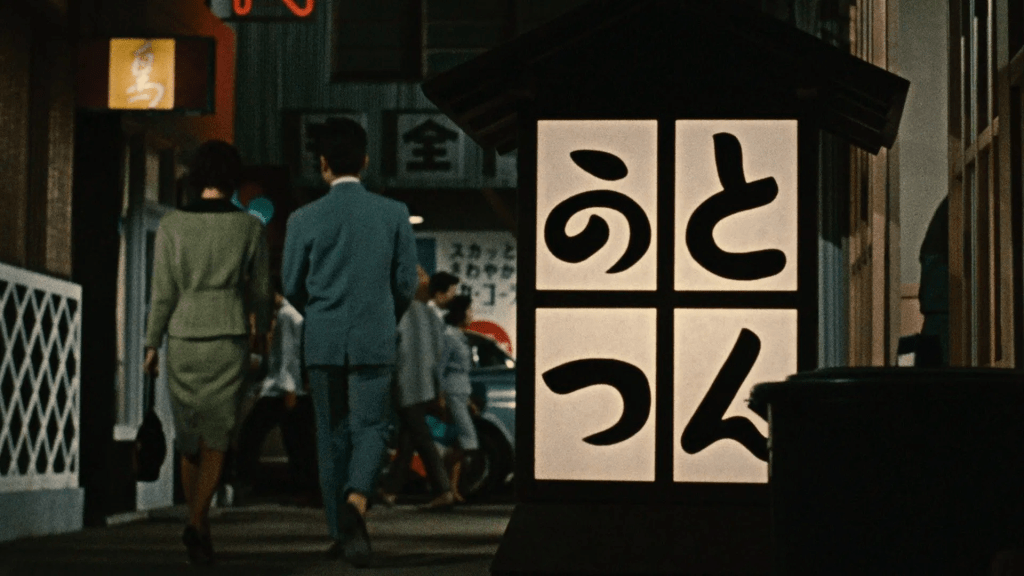
And yet according to Richie the quintessentially Japanese aspect of Ozu’s films, and in Japanese film in general, is his systematic and obsessive framing and sense of composition that reigns over every shot. ‘Perhaps the most traditional aspect not only of Ozu’s films but also of Japanese cinema as a whole is its long-lived and still-continuing concern for composition’ (p59, Richie, 2012). Richie goes onto say that it is ‘an acute compositional consciousness should be part of the visual style of the country’ (p59, Richie, 2012). And it is Ozu’s concentration upon ‘spatial formality’ Japan’s traditional narrative means, the suji, emphasizes sequential flow, connection, association. The presumed Japaneseness of Ozu’s approach- his emphasis upon effect rather than cause, upon emotion rather than intellect- coupled with his ability to metamorphose Japanese aesthetics into terms and images visible on film. And this has led David Desser to say: ‘I do think, however, that Ozu has drawn inspiration for his spatialization from aspects of traditional Japanese culture, including, most prominently, architecture’ (p24, Eleftheriotis and Needham, 2006), for the ‘space itself can shift’. And this is fluid aesthetic is represented by the modular form of the Japanese home with its screen that slide and displace space in various ways. Finally, this resulted in a clean, transparent structure, something which Ozu admired both because of its rootedness in Japanese tradition and how it reflects a rigorous mirroring of national traditions that make Ozu, ‘the most Japanese of all directors’ (p123-124, Richie, 2012).
David Bordwell has said that Ozu’s ‘composition can play hide-go-seek with quilts and ketchup bottles’ that ‘arouse our attention’ and discloses to us ‘the shapes and surfaces of the world as they change’, [ONLINE, Bordwell] and each shot is meticulously composed down to the finest detail. And Bordwell asserts that ‘Ozu’s bold play with graphic qualities—lines, masses, and colour from shot to shot is without peer in mainstream filmmaking’, and the process of Ozu’s frame subjects ‘the entire visible world to a precise patterning’. The surface texture of these films would entrance us even if there were no story to follow (like a form of pure poetry) and it is a poetry that ‘opens up a vast realm of purely cinematic possibilities’, and for someone like Bordwell, ‘no filmmaker has come closer to perfection’ [ONLINE, Bordwell].
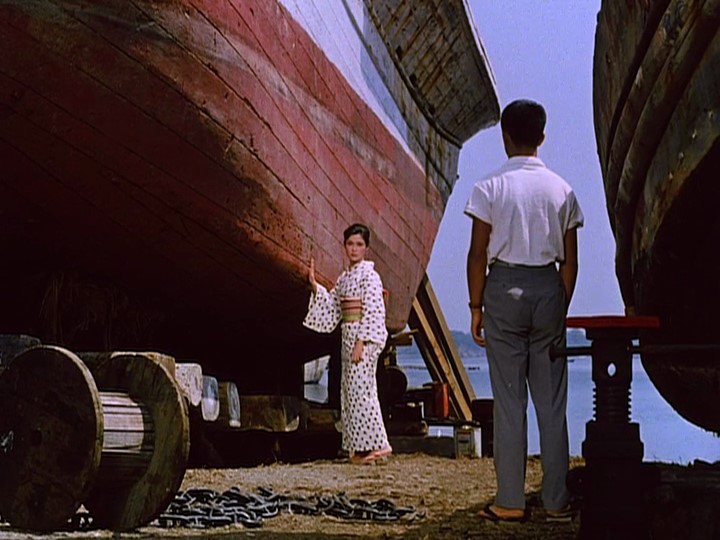
Perennial truths in An Autumn Afternoon
In terms of Ozu’s uniqueness what differentiates him from the likes of Kurosawa ‘is the way in which the former is maintained within a role that perpetually raises questions of the uniqueness of his films and makes Japanese-ness, otherness and modernism integral components of his identity as an auteur’(p12, Eleftheriotis and Needham, 2016). And if we look at Ozu’s final film, An Autumn Afternoon (Ozu, 1962), we see all his aesthetic tropes, stylizations and common themes concentrated into an intense distillation of his life’s work. Again we see many of his empty-shots, mainly industrial, in comparison to the shots of nature in Late Spring. ‘Empty rooms, uninhabited landscapes, objects (rocks, trees, beer bottles, and tea kettles), textures…these all play a large part in Ozu’s later films’ (p123, Richie, 2012). The shots in An Autumn Afternoon are clearly more industrial, with red barrels, telephone poles, vertical chimney stacks, with even urban wastelands featuring. Nevertheless these shots are very beautiful. Thematically Ozu revisits much of the familiar terrain- indeed the first lines, the first scene, are about marriage and young woman being hurried into marriage. And the patriarch of the Hirayama family, the father Shutei, also the same actor who played the father in Late Spring, believes it is his duty to arrange a marriage for his daughter Michiko. And there is also the continued fascination with school in Ozu’s films, with the old school teacher ‘the gourd’ invited to a reunion, even forty years after leaving school, such is the symbolic significance of school in Japanese culture.
Ozu utilizes ellipsis extensively in An Autumn Afternoon, especially at the end of the film when the father has finally found a suitor for his daughter. And just like Late Spring we experience a significant ellipsis when we jump from talking of an arranged introduction to a scene just before the wedding- we then have another ellipsis to after the wedding , and at the end we have again the father of the bride alone. In Autumn Afternoon we have less overt symbolism, such as the peel of the curved apple skin falling or the waves of the sea. The final words are ‘all by myself’, as the shadow of loneliness seems to loom ominously over everyone, especially the old. We then see a series of empty shots of house, then we go back to the father sobbing in tears, bowing his head, a parallel shot with Late Spring.
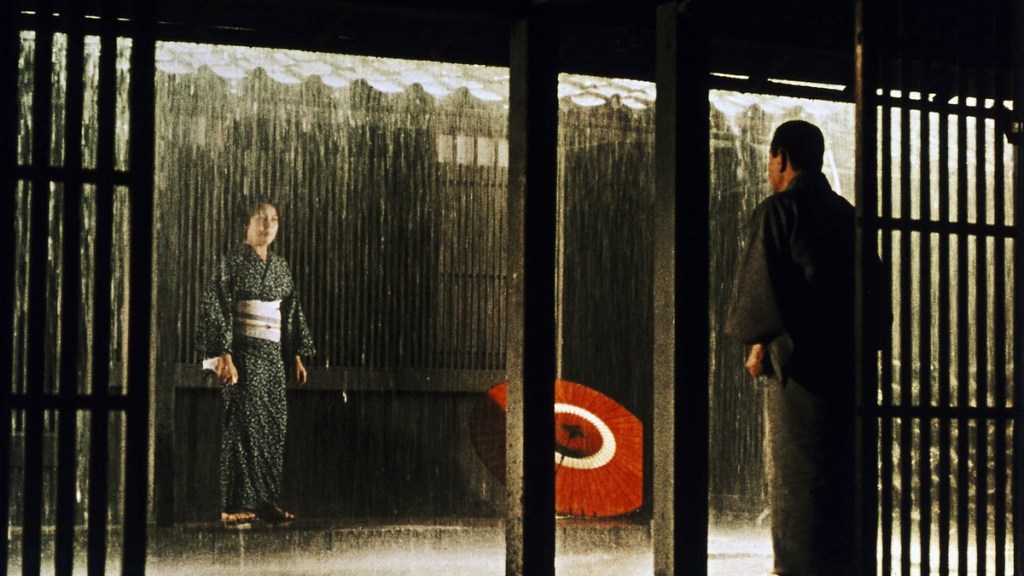
‘I tried to portray the cycle of life [rinne]. I wasn’t interested in action for its own sake…’ (p121, Richie, 2012) And like Late Spring, where the cycles are directly related to nature, as in the symbol of the ebb and flow of tides, In An Autumn Afternoon the cycle emerges out of the patterns and repetitions of human life itself, where little of the perennial problems of the human experience seem to change. ‘For example. The films of Ozu Yasujiro often evoke the theme of the transience of human life’ (p17, Bordwell, 2012) and many have pointed out this is most emphatically emphasised in his celebrated empty-shots. Such highly stylized compositional shots represent for scholars like Yoshimoto believe are ‘determined through their supposed aesthetic embodiment of Zen (as Schrader does)’ (p13, Eleftheriotis and Needham, 2016). Ozu’s intermediate spaces are evidence of Japanese aesthetic practices and reference Zen Buddhist ideas, according to Paul Schrader even sometimes called ‘still life’s’ that are devoid of human life, and ‘Ozu achieves a particular poignancy in many of his still life’s by highlighting the paradox of humanity’s presence by its absence’ (p22, Eleftheriotis and Needham, 2016). A truth so beautifully portrayed in the penultimate scene of End of Summer where we see ‘inside’ the grief of the attached family as they look at the smoke of the crematoriums chimney stack, in contrast with the simple detachment of those on the outside working at the river who see it: ‘new lives…successfully replace those that die’. ‘Yes’, the woman says, ‘How well nature works’. They then go back to work, accepting the flow of life and death with simple serenity. For it is Ozu’s insistence upon these virtues of ‘restraint, simplicity, and near-Buddhist serenity’, that accentuate his sense of ‘Japaneseness’, as these are ‘qualities which still remain as ideals in the country’ (p124, Richie, 2012). It is Ozu’s emphasis on such subtle perennial truths of the human experience, such as transience, that proffer’s such enduring quality for his films within the context of Japanese culture, indeed world cinema. And even when Ozu died in 1963 of cancer on his 60th birthday, his grave which bears no name, merely the character ‘mu’, that can be translated as ‘nothingness’ or ‘emptiness’- and so Ozu’s film life, largely preoccupied by emptiness, came full cycle, as his films did, like the seasons of his film titles, with his own death.
BIBLIOGRAPHY
[ONLINE, 2013] “Restored Ozu Films To Debut For 110Th Anniversary Events | The Japan Times”. The Japan Times. N.p., 2017. Web. 25 Apr. 2017.
Richie, Donald. A Hundred Years Of Japanese Film. 1st ed. New York: Kodansha USA, 2012. Print.
[ONLINE, Bordwell] “Directors: Ozu Yasujiro”. Observations on film art. N.p., 2017. Web. 28 Apr. 2017.
Orr, John, and Olga Taxidou. Post-War Cinema And Modernity. 1st ed. Edinburgh: Edinburgh Univ. Press, 2007. Print.
Takemaru, Naoko. Women In The Language And Society Of Japan. 1st ed. Jefferson, N.C.: McFarland, 2010. Print.
Eleftheriotis, Dimitris, and Gary Needham. Asian Cinemas. 1st ed. Edinburgh: Edinburgh University Press, 2006. Print.
Bordwell, David. Poetics Of Cinema. 1st ed. Hoboken: Taylor and Francis, 2012. Print.
 craigdevine88-dkjtq
Leave a comment