by CRAIG DEVINE
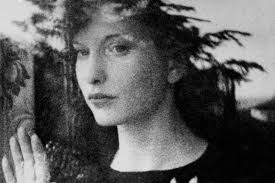
INTRODUCTION
A brief contextualization of Maya Deren in the history of 20thC Modernism.
Maya Deren can be historically contextualised in an era when film theorists such as Rudolph Arnheim, Andre Bazin, Jean Epstein, or Sergei Eisenstein within the tradition of modernist film theory were preoccupied by the assumption of medium-specificity. And in her An Anagram of Ideas on Art, Form and Film (1946) Maya Deren ‘insists that film is primarily of visual medium and therefore that film art must communicate through its imagery, not through theatrical or literary dialogue’ (p48, Nichols, 2001). Today we would view this as a form of essentialism that delimits film as a heterogeneous form of creative expression. Yet such theorization led to a revaluation of the function of film as a medium of expression- and just as much as the great films- did much to elevate cinema to the status of art. Deren’s short film Meshes of the Afternoon (1943) won the Grand Prix Internationale for 16mm experimental film at Cannes, and it was no surprise she was chosen to sit at The Poetry and Film Symposium of 1953. Here is one of her articulations of the ‘vertical-axis’ in her cinema of poetry, transcribed from the symposium: ‘…It is a ‘vertical’ investigation of a situation, in that it probes the ramifications of the moment, and is concerned with its qualities and its depth, so that you have poetry concerned in a sense, not with what is occurring but with what it feels like or what it means’ (p64-65, Nichols, 2001). Deren did not advocate the complete renunciation of what she referred as its antipodal ‘horizontal’ structure of conventional narrative. What she objected to is its monopolization of narrative form, largely imposed by what Noel Burch termed the ‘institutional mode of representation’, and it’s marginalisation of the equally salient function of the vertical poetic axis of a narrative. And Deren utilized a poetic manipulation of space and time to create combinations of allegorical rituals of a new relativistic universe from new discoveries in science- I will employ textual analysis of her films to illustrate these filmic principles.
For Deren art is a form that creates experience as powerful as any ordinary order of experience, what she terms the ‘ritualistic’ form, and endorsing the utilization of poetic methods to do so; believing ‘that a filmic adaptation of the methods of poetry is the only proper means of creating film art’. And so this suggests that Deren believed the ‘poetic is… a compositional methodology for visual forms such as cinema’ (p64, Nichols, 2001), and this poetry would assume the expression of Deren’s ‘stated conviction that film form should be ritualistic’ (p50. Nichols, 2001).
The poetic manipulation of space-time as a filmic form of ritual allegory.
And it would appear that, according to John Fox (pdf, Fox, 2008), a key influence on Deren was her immersion in ethnographic ideas, even before she became a filmmaker. Deren was exposed to ritualistic dance by choreographer and ethnographer Katherine Dunham. And in 1942, a year before filming Meshes, ‘Deren published an article entitled ‘Religious Possession in Dancing,’ which consisted of a comparative analysis between possession in Haitian Voudoun’ (p5, Fox, 2008). And so we can see the aesthetic structure of allegorical ritual of Deren’s film form assumed in her major experimental films Meshes, At Land (1944, Deren) and Ritual In Transfigured Time (1945-46, Deren), and even Study in Choreography for the Camera (1946, Deren). And it is Ritual in Transfigured in Time in particular is a ritual film form that examines various social rituals in modern culture. Ritual for Deren, in this film is, ‘that state which means crossing of an individual from one state into another’ (p212, Deren, 2005). And she went further in stating that the patterns and rhythms ‘created by the film instrument, transcends the intentions and movements of the individual performers, and for this reason I have called it Ritual’ (p145, Nichols, 2001) Ritual in Transfigured Time was made in the year she wrote Anagram: Deren insisted on the importance of the above principles and described the film as ‘ritualistic both in form and content’ (p50, Nichols, 2001).
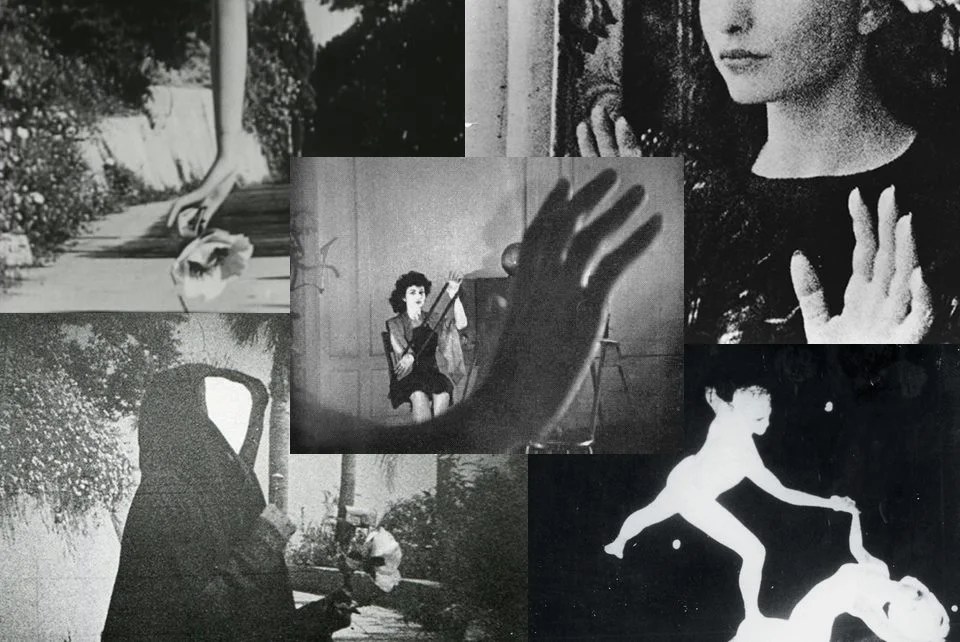
In Ritual in Transfigured Time we see three major ritual sequences that are rituals within rituals. These rituals are formulated through radical deformations and manipulations in spatial and temporal dimensions: for example in the first ritual the young Rita Christiani is rolling the wool up with Deren- is Deren her in the future? As she looks over her shoulder to see Anais Nin standing in a doorway, is this her in the distant future? Or is Christiani the figure played by Deren an image of her own past? At the end of the first ritual sequence we see Deren suddenly vanish. She doesn’t return until the end of the film. In the second ‘ritual’ sequence of the social gathering in the dining room, Christiani appears to be lost in the maze of bodies, male and female, circling each other, as though in courtship, with some pursued and others spurned- so we see this allegorical emphasis on courtship. We see the same body movements being repeated, as though transfigured into a dance, a ball, a waltz, like a ritual dance in a circular motion. The camera itself participates in this waltz and becomes part of the creative geography of the film; it becomes an extension of the dancers. This ritual sequence of creative geography transforms the dining room into an endless dimension, like outer space. The final sequence is in line with Deren’s vertical principle of developing ‘the idea of cinematic magic in terms of space and time’, we see the male dancer chases Christiani through a series of archways in a cloister, we see her older self as Anais Nin again, then she suddenly metamorphosis’s into Deren, and the man then grabs at her, but she escapes his grasp. We see her again through the radical dream logic of the films creative geography; she effortlessly glides from a stone cloister into the sea. Deren wades through the water, until she submerges, sinks, drowning, into the sea as a bride wearing a wedding dress, forever trapped in negative image. At the end we’re not sure if the bride is Deren or Christiani as she sinks down into the deep sea, and we’re left without a singular answer.
The ritual allegory of the film confronts us with a powerful sense of meaning, a meaning much like surrealism, with the way in which it recontextualizes images and creates a strange sense of incongruity. It is this juxtaposition of garden, park, the sudden metamorphosis of Christiani to Deren, to the sea, to a bride drowning in her wedding dress (in the form of a negative image), that creates this sense of a dream made real. A discussion of Pasolini’s cinema of poetry, and Deren and Pasolini’s sharing of a common origin in surrealism- as well as a rejection of conventional narrative cinema- will follow in chapter two. But first we ought to define Deren’s notion of poetic verticality in relation to David Bordwell’s study of the horizontal narrative of Hollywood cinema.
CHAPTER ONE: Bordwell’s Classical Hollywood cinema : what is the horizontal axis?
Deren was mostly disparaging in her opinions concerning mainstream Hollywood filmmaking, and often claimed it was an impediment to films status as an art form. And one of the primary reasons identified was popular cinema’s dependence upon horizontal narrative founded upon reductive cause-effect logic. Deren believed that it was cinema’s appropriation of theatrical and literary forms into its own internal narratological structure that had caused it to neglect its own visual form of expression, ‘the narrative pattern has come to completely dominate cinematic expression in spite of the fact that it is, basically, a visual form’ (p31, Deren, 2005). And according to David Bordwell, when most people talk of going see a film, what they mean is they are going to watch a narrative film, a story, and our expectation is that we come ‘prepared to make sense of a narrative film’ (p72, Bordwell, 2013). And it is the spectators expectation of making sense of narrative, by means of identifying the cause and effect links, that leads to the spectators satisfaction, as he affirms, ‘In creating a classical film, the filmmakers adjust time to fit the cause-effect progress of the story’ (p98, Bordwell, 2013 ). And Bordwell is clear that our development of meaning and sense in a film’s narrative is driven by the engine of its plot, for narration is always moving towards the culmination of its plot. And narrative cinema rarely lingers on what Deren would refer to as the ‘investigation of the moment’.
Another feature of classical Hollywood filmmaking is to have a single character as the fuel of the plots engine. Usually, the changes are brought about by characters triggering and reacting to events, ‘characters play causal roles within the film’s narrative form’ (p77, Bordwell, 2013). The narrative must be goal orientated. This notion of the individual hero driven narrative of horizontal cinema is far from Deren’s notion of the ritualistic form that ‘treats the human being, not as the source of the dramatic action, but as a somewhat depersonalized element in a dramatic whole’ (p58, Deren, 2005). Deren was seeking in the vertical manipulation of temporal and spatial structures in her allegorical ritual film form- what she referred to as the ‘manipulation of time and space’ that becomes an integral quality of a films organic structure.
And lastly, Bordwell in his analysis of classical Hollywood cinema emphasises closure, for classical filmmakers prefer to leave ‘few loose ends unresolved, the films seek to wrap things clearly’ (p99, Bordwell, 2013). Bordwell recognises that the classical structure of film can be experimentally utilized by filmmakers through making the sequence more complex, such as re-arranging the chronology of how the plot unfolds. And he insists that, the classical film narrative can be presented in diverse ways, ‘rendered as different plots- and each variant is likely to have different effects on the audience’ (p75, Bordwell, 2013). They always end with some level of closure that will satisfy most spectators. And it is this underlying principle that connects narrative films made in the Classical Hollywood form, is they are driven by a motivation to satisfy the spectator with a comprehensible sense of narrative closure. And such films of the Hollywood classical tradition ‘usually presents a happy ending’, with narration tending to be ‘highly communicative’ (p11, Teixeira, 2009 ).
Bordwell’s conception of classical continuity film in relation to Meshes of the Afternoon- Meshes as allegorical ritual of a semi-psychological reality.
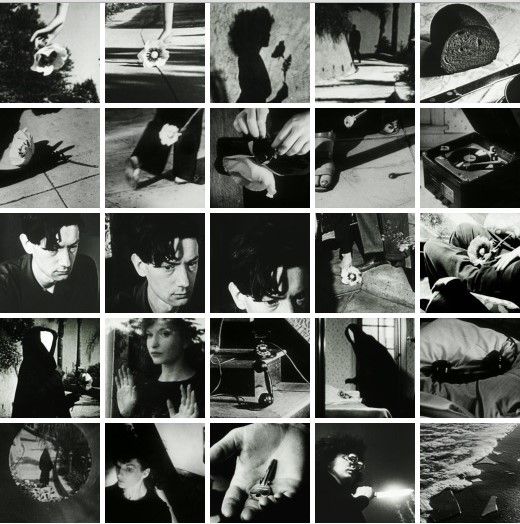
With Meshes Deren began the project with the intention of creating a film form that would function as an allegorical ritual for representing ‘a semi-psychological reality’ (p49, Nichols, 2001). Meshes has no conventional plot crisis, no cause-effect logic, and apparently no goal orientated character. The very first shot of the film is a mannequins arm dropping a plastic sunflower, and then the arm suddenly vanishes. Even though its 3 and a half minutes before she falls asleep, the world is already appears to be out of synch- how? The rest of the film is a presumed dream, even before then things hint at disjointedness, of anomaly of sorts. The slow motion key falling down the stairs, knife that falls from the bread, the telephone off the hook, and the record playing- do these images hint that something has already happened? Are they suggestive of future events- omens? After she has fallen asleep we see these objects transformed into recurrent motifs, repeating continuously, yet different each time we see them, such as the knife on the stairs, or under the bedclothes, or the record player next to the female figure as she sleeps on the chair. In terms of individual character driven plot points: is it the female figure making these things happen? And yet she doesn’t appear to be in control of what is happening, as most of it is unpleasant or anxiety inducing- is it then a nightmare? Whose point of view are we seeing events through? The camera is more or less disembodied for most of the first 5 minutes, until she falls asleep, then we seem to move around in a disorientating angles and POV shots from the female figure, to her multiples, to brief perspective of her lover at the end, to no one at all. Bordwell assures us that ‘film characters typically have a visible body’ (p77, Bordwell, 2013 ), and yet we are not introduced to the female figures face until 4:37 in, nearly a third of the way through the film. At the other extreme Deren is multiplied into four identical copies, all with apparently competing motivations.
Antonio João Teixeira (pdf Teixeira, 2009) has written an essay based on David Bordwell’s ideas around narrative comprehension and how viewers to make sense of a film like Meshes. Teixeira describes Deren’s work as producing ‘cinematic work which deliberately confuses’, confronting an audience with ‘surrealistic elements in its narrative’. Bordwell argues that in classical cinema, reality is assumed to be ‘a tacit coherence among events, a consistency and clarity of individual identity’ (Bordwell, p. 206.1985) But in an art film like Meshes, with four separate and yet apparently identical figures, identity is an uncertain process or is a state of flux. Teixeira believes ‘art cinema narration, because it takes its cues from modernism, challenges this notion of the real’, especially in the ways dreams are presented ‘does not differ from the way “reality” is presented’ (p19, Teixeira, 2009). That Meshes defies narrative logic Teixeira argues it must be accepted as part of the stylistic narrative, such as when a key comes out of a mouth, or when placing the knife on the table and it turns into the key, in front of the other two copies of herself, so it is that we are in a narrative world with its own logic.
In Deren’s Meshes, we have an individual character that changes into four different versions of herself, and so we see the ideological division that separates the conventional narrative comprehension of Classical Hollywood with the modernist inflected European Art film, ‘Art-film presents ambiguity, unlike classical cinema, which is denotatively unequivocal’ (p18, Teixeira, 2009 ). And it is to this tradition Maya Deren leans, a tradition where narrative comprehension is secondary to the poetic articulation of irrational enlargement, and the concrete manifestation of the oneiric power of dream, that is made real by the photographic image. This ‘irrational enlargement’ is a subject we will visit later in the section on surrealism and poetry.
Deren herself had said of Meshes that its intended function was to ‘create experience- in this case a semi-psychological reality’ (p49, Nichol, 2001), in the form of a ritual allegory composed of her verticalized tropes as a means of investigating the moment: the patterns that repeat, with recurrent metamorphosis of objects, surreally juxtaposed, such as the key, to knife, a knife like a mirror, to flower, back to the knife that smashes the mirror. It is the trance like power of this rhythmic editing, its hypnotic, ritualised repetition, or the ‘girl in the penultimate shot: now a potency, armed with a knife, bulging black eyes like a giant fly’s’ (p17, Teixeira, 2009)- these then are the ‘elements that viewer now takes into account’, and here Texeira suggests that ‘ a logical, classical narrative’ would nullify the resonant poetic force of the images. This style of filmmaking by narrowing its focus on mood, feeling and textures, has ‘more psychological depth’ and as art film it ‘senses that life is more complex than art, and thus leaves many questions unanswered’ (p20, Teixeira, 2009).
It is here we might ask is where the power of the visual logic of Deren’s ritualized allegorical film form is generated. The line of the argument at present needs to examine the visual power of Deren’s surrealistic aesthetic, outside conventional narrative, and how it achieves its radical shock to the senses.
CHAPTER TWO: Pasolini: the Cinema of Poetry. Surrealism in Deren.
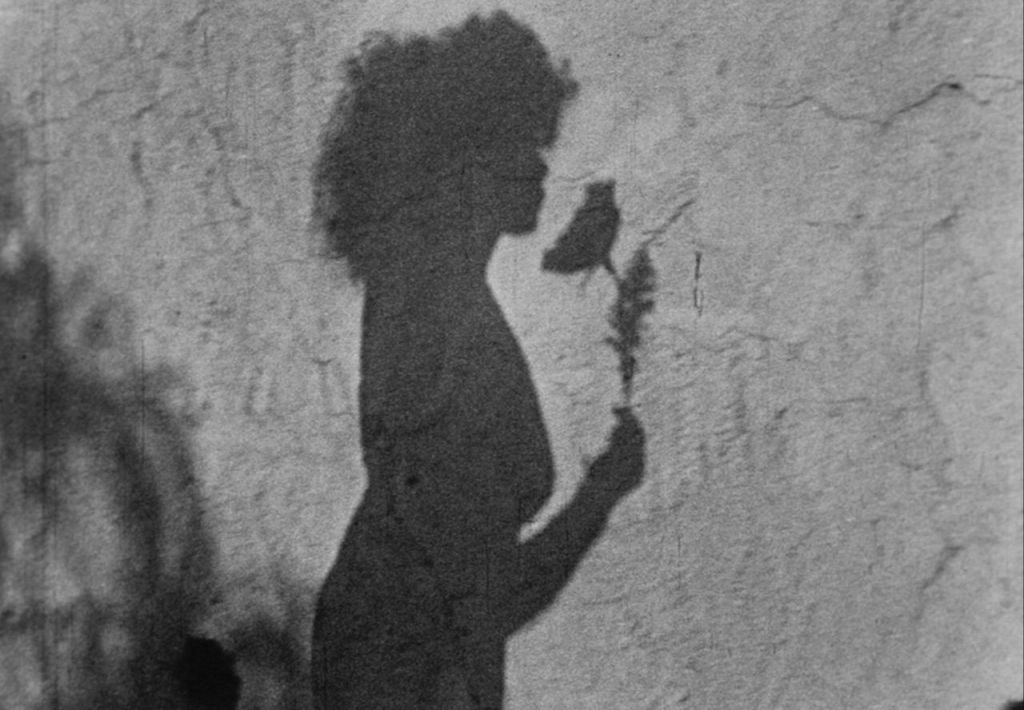
Possibly one of the first conceptual analysis of this question came from the Italian film director Pier Pasolini in his 1965 essay, ‘The Cinema of Poetry’ (Orr, 2007). Although Pasolini emphasises the inherently poetic nature of the film-image, in that it’s indexical framing of natural objects automatically generates an evocative ‘poetic’ power. But he also goes onto say that such inherent poetry is not the ‘cinema of poetry’, as this is constituted by specific stylistic tropes that characterise this cinematic form. This emphasis on the poetic nature of objects is similar to how Maya Deren sought ‘resonances that might derive directly from objects, concretizing the abstract qualities inhering in poetry’ (p235, Keller, 2015); led him to conclude, according to John Orr that the ‘film image is irrational’, like an excess of meaning that escapes rational conscious articulation.
Andre Bazin, the reality of the photographic image and the aesthetic power of the surreal.
So can we answer how Deren’s surrealistic aesthetic generates its visual power, its shock to the senses, particularly in relation to Meshes? Well Andre Bazin in discussing the ‘Ontology of the Photographic Image’ in What is Cinema declares ‘every image is to be seen as an object and every object as an image’ (Bazin, p16, 1967), so that the power of immediacy of the indexical register is its facticity. From this starting position of Bazin’s insight Pasolini insists that because cinema, must adopt specific technical devices in order to reveal the ‘original oneiric, barbaric, irregular, aggressive, visionary quality of cinema’ (p4 Orr, 2007). And for Pasolini, and Deren, the horizontal narrative, with its heavy emphasis upon cause-effect logic, and comprehensible closure, conceals the oneiric power of cinema. And the progenitors of this oneiric power of the cinema of poetry are the surrealists, and most notably Luis Bunuel with his landmark film Un Chien Andalou (1929, Bunuel, Dali). Bazin insists that for the surrealist the ‘logical distinction between what is imaginary and what is real tends to disappear’ (p15, Bazin, 1967), and he says the surrealists value photography so highly as it ‘produces an image that is a reality of nature’ (p16, Bazin, 1967). The reality of the photographic image produces a ‘hallucination that is also a fact’, that intensifies the presence of the irrational. This is what Andre Breton referred to as ‘surreality’, the meshing of the dream and reality, and this is what confers such onieric power on Derens images.
And it is here we can see that similarities of Deren’s film practice in the oneiric narratives such as Meshes, especially to Un Chien Andalou. We can see a synchronous spirit with the fundamental principles of surrealism, for Deren said of the cinema of poetry ‘creates visible and auditory forms for something that is invisible’- and such representation intensifies the augmentation of the irrational vision by means of the indexical power of the photographic image. Surrealism then is the expansion of reality, and Bazin identifies this with the transfiguring power of the photographic process, a surrealist enlargement. And the irrational enlargement of a film is a ‘strategy of poetic’ thought that liberates an object from its rational more utilitarian characteristics- an example of this in Meshes is when a mirror , juxtaposed, is transposed as a ‘face’ on the mysterious black figure who haunts the female figure.
It is the photographic immediacy of these surreally juxtaposed images that viscerally shocks the spectator. And Deren, in all her films demonstrates ‘the idea of cinematic magic in terms of space and time’ (p205, Deren, 2005); a cinematic magic where we witness its power to ‘collapse and expand spatial and temporal dimensions’ (p57, Keller, 2015), as when we see the girl with the black goggles in Meshes pick up the knife and walk ‘from beach to grass to mud to pavement to rug’ in the flash of a single sequence. It is the photographic immediacy of these surreally juxtaposed images that viscerally shocks the spectator. And for Deren these sorts of cinematically vertical structures of temporal, spatial collapse, identity flux, deformations, especially in prolonged slow-motion action shots; these combine to leave the spectator disorientated, especially in Meshes of the Afternoon. And for surrealism the ‘value of cinema lies in the disorienting power it provides the viewer to enlarge the film‘ (p22, Lowenstein, 2015).
Everything in Meshes seems to be designed to elicit disorientation in the spectator, from the obsessive repetition of the set series of object-images, of knife, key, flower, every time in subtly shifting contexts, in a circular logic. There is even a shifting perspective in terms of the POV shots, with the camera twisting and swirling in various directions at the stair scene, deliberately destabilizing the viewer’s sense of space. And so as Deren in Meshes ‘splits’ for the first time, we are unsure afterwards who the ‘real’ her is- who is it running as she stands at the window as she chases the mysterious figure? Nothing is certain or predictable in Deren’s film world, and everything designed to disorientate the spectator.
CHAPTER THREE: Deleuze, Time-Image, Deren and the rituals of relativity.
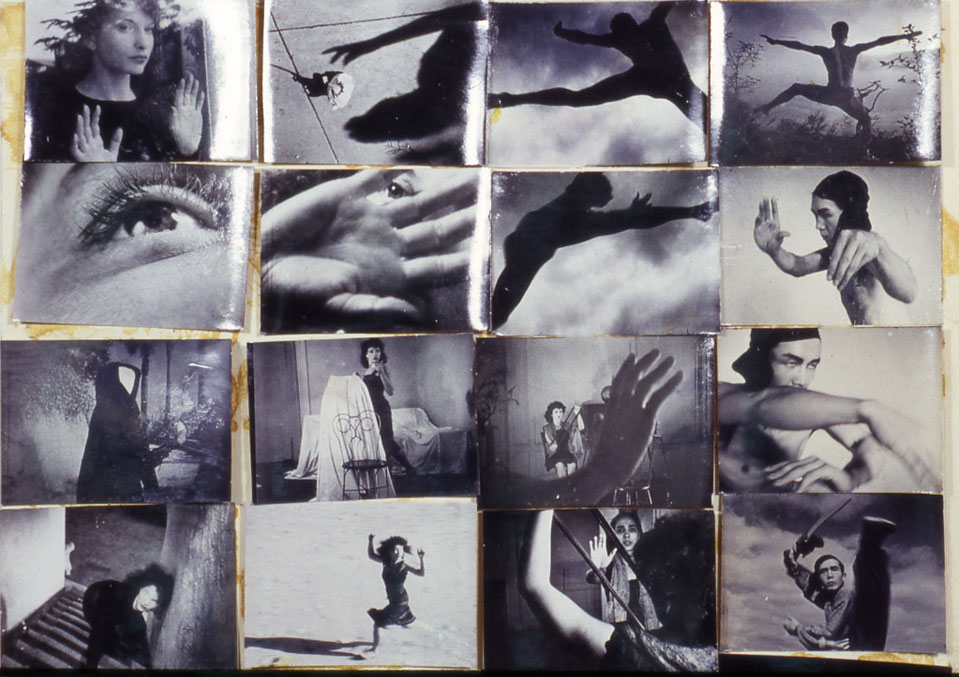
Anna Powell refers to altered states of consciousnesses as most prevalent in ‘philosophical and psychological types of cinema’ (p23, Powell, 2007). Most of the cinematic tropes of Deren utilizes in Meshes, occur in a ‘state between dream and waking, these dream contents spill over into actuality by material manifestation’ (p10, Powell, 2007) and best represent this semi-Deleuzian topography. Powell argues that films that exhibit stylization that is significantly different from normative cinema often manifest characteristics of Deleuze’s time-image. Powell, in reference to Deren’s most celebrated film, ‘more experimental dream-films, like Maya Deren’s Meshes blend dreams and waking in a seamless continuity and is a film ‘where cinema is engaging process of actualizing various conceptions of ‘time’’ (p135, Colman, 2011). How does this actualization manifest itself? According to Deleuze through ‘crystalline images’ or ‘seeds of time’ that occur on screen- and Deleuze refers to this time-image in various ways, such as ‘the time crystal’, or ‘mirrors of time’. The crystal of time is two sides of an image, the ‘actual’ and the ‘virtual’ or the ‘very being of cinema’s time-process, its ontological process of the material expression and assemblage of ideas of time’ (p138, Colman, 2011). Just like Deren’s conceptions of the poetic vertical axis of narrative Deleuze cinema of the time-image moves vertically rather than horizontally, it is a ‘philosophically dense and duration-centred cinema’ (p38, Powell, 2007). This is where Meshes ‘externalizes an inner world to the point where it is confronted with the external one’ (p27, Powell, 2007), so that a mythological domestic space is so defamilarized we are confronted by ‘a sense of being lost in time’ and it manifests what Deleuze calls states ‘of reverie, of waking dream, of strangeness or enchantment’ (p37, Powell, 2007).
In much of Deren’s work we also encounter images that act ‘like magnets and they pull other ideas to them’ (p33, Powell, 2007). And Ritual in Transfigured Time (Deren, 1945-6) as a film as ritual form, with intensive qualities achieved ‘not in spatial terms alone, but in terms of time created by the camera’ (p32, Powell, 2007). Showcasing ritual and dance, the whole film appears to be filmed in slow-motion, which induces a strange rhythmic affect, and creates the sensation of being under water, where our floating state is slower. And strangely the main figure, in the form of Deren, finally drowns as a negative underwater. The imminent alterity of Deren’s visceral images, their concreteness, via the radical manipulations of time and space, acting like ‘seeds of time’ that Deren marks out through a ‘meandering repeating and circular logic’ (p53, Keller, 2015) so that she suggests that ‘actualized images have a virtual dimension in connected acts of memory’ (p28, Powell, 2007). These acts of memory repeat themselves with loaded significance, omens, with added weight, by means of ‘subtly shifting replications’. Deren defamiliarizes everyday objects, recontextualizing them, multiplying them, through the sudden appearance of an assemblage of set images such as a knife, mirrors, keys, a sunflower, that act like ‘circuit of the internal limit’ a ‘zone of recollections, dreams, or thoughts’, that Deleuze termed ‘seeds of time’, where ‘the past is present, but is in fact altered by its present state’ (p137, Colman, 2011); so ‘actualization of the past is the circuit’ (p157, Colman, 2011). And examples are déjà vu, memories and dreams. This circularity suggests that it becomes ‘the entire composition of time‘and so ‘the circuit of ‘exchange’ between actual image and virtual image creates new time-images and different types of narrative strategies’ ( p68; p71, Deleuze, 2000). Powell insists that Deleuze believed these formations serve to create a single process of ‘automatic subjectivity’ that unites ‘image, thought, and camera’, and that somehow these formations offer us ‘insights into the mystery of time itself’ (p25, Powell, 2007). And it would seem for Deren, according to Claudia Kappenberg (2013), she appeared to prejudice a mobilization of her images through a metaphoric framework, or I would argue ritual allegories. These ritual allegories represent an exploration of ‘a new age and relativistic universe’, heralded by Einstein’s insights into the nature of material reality.
And Deren, was hyper-modern in her embrace of science, technology, and she believed an artist must ‘transform the material world by playing with the capabilities of the medium to manipulate space, time and movement’ (p55, Nichols, 2001). Deren insisted art must be relevant to the demands of the contemporary moment by comprehending the ‘large facts of its total culture and, at best, extend them imaginatively’ (p55, Nichols, 2001). And Deren’s films, explore the psychological implications of new conceptions of temporality, that had arisen from discoveries in physics and how ‘Einstein’s discovery of relatively, have indelibly altered our long-held-conceptions of time and space’ (p56, Nichols, 2001). This is why she was so committed to ‘creating movies with a new dimension: time’, and At Land in particular explores our contemporary fate as human beings existing in this new relativistic universe of Einstein’s- a dimension where there are no absolutes and from a certain perspective all seems to exist in simultaneity.

CONCLUSION
The visceral power of Deren’s images, think of the girl with the goggle’s and the knife in Meshes; the apparently randomized sequences, the irrational enlargement of shots already considered, particularly in Meshes; the eliding of narration, and intense verticality expressed in moments of pure poetry. This is equivalent to surrealism. Its film stripped of narrative function, of cause-effect logic, of simple rational comprehension. It is released into Pasolini’s ‘original oneiric, barbaric, irregular, aggressive, visionary quality of cinema’. And Deren’s clearly presents aesthetics of specific poetic strategy that meshes dream and reality throughout her films, intensifying the presence of the irrational: the surrealistic expansion of reality to accommodate wider dimensions that cannot be contained in horizontal narrative form. Bazin referred to this as factual hallucination; the transfiguring power of the photographic process- and this is the method Deren adopts, identical to the surrealists, for transfiguring horror, terror, the irrational, and its enlargement in the ‘real’ of photography.
These poetic strategies, seems fairly obvious in a body of work like Maya Deren’s- an oeuvre that, as Deren said are ‘to other films as poetry is to other forms of literature’ (p101, Kappenberg, 2013). And yet the ambition of defining what poetry, a notoriously nebulous concept, and when combined to film it becomes even more elusive to a precise classification, is problematic for anyone researching such an area of study. Even the characteristics of Deren’s verticality is difficult to identify in terms of the devices she adopts, escaping the methodologies we use to describing them through textual analysis of the films: the films are a movement through temporality, with spatial mobility as secondary, and that in itself can be a difficult to articulate succinctly. And as Raymond Bellour insisted ‘the film text is not readable like a literary text’ (Bellour, R., 1975), as film and literary analysis do not share the same medium, and by freezing the movement of the image via analysis we lose films essential quality. It’s clear she didn’t believe in the complete renunciation of the horizontality, but was in fact opposing its hegemony as a narrative driver in cinema; indeed Deren recognized that the forward movement of the horizontal drive, should run parallel with the poetic verticality in a film, as in moments of linear disruption. For example in At Land we are always going forward toward the next associationally connected sequence that relate to each other within a totality, for as Deren said, ‘A work of art is an emotion and intellectual complex whose logic is its whole form’ (p66, Deren, 2005). At the end of the film we see Deren steal a chess piece from two female chess-players on the shoreline, we then see Deren observe herself running away from the same position; then we reverse through all the previous sequences where she observes herself running away from those specific locations- there are six identity’s for each location- does each one exist forever in each location? Or is it all the same person that just happens to exist simultaneously in each location? Is individual identity an illusion? We cannot gain a definitive answer to these questions. These elements all inherit their meaning through a recontextualized relation to other elements in the totality, hence mythologically representing an ‘ontology of relations’, which could be assimilated to something like an allegory for the ‘process philosophy’ of modern science, and referenced in the thought of Deleuze.
And such allegorisation foregrounds Deren’s interest in ritual form, which according to Fox, her emphasis on the depersonalization processes of ritualism was methodologically problematic ‘for an artist aiming to implement these insights within a society that does not recognise ritual or collective creativity as forming a legitimate part of its own make-up’ (p4 Fox)- so why did she emphasis ritual so strongly? And because of her interest in Haitian dance rituals, Voudon ceremony, it appears that ‘Deren’s philosophy of art, with its de-emphasis of individual psychology and stress on ritual, stands in tension to her promotion of art’ (p6 Nichols, 2001). And yet we cannot lose track of her modernist stylistics. We ought to view her ethnographic interests in ritual, like other proponents of Modernist art, such as Picasso’s cubist ‘African Period’, as a widening of the artist’s sources of inspiration. Ultimately she abandoned her Haitian project, realizing that it was part of a larger complex network of cultural ideas. And this in a sense may have been what Deren was seeking to do with film art as ritual form in her series of short films: how she identified the function of ritual as the transmission of communal cultural experience beyond the subjective confines of the individual, and that somehow cinema, via artistic formalism, could serve as a similar function as ritual. Maya Deren’s film form was concrete mode of poetry creatively utilizing reality, and stylistically rearranging forms of time and space to generate a meaning more intense than the abstract literary poetry locked inside its own verbal limits. Deren’s ‘vertical” cinema’, disrupts horizontal narrative development to ‘dwell on resonance and layers of meaning rather than only rushing onwards towards the finish’ ( p23, Keller, 2015). And the ritual allegories of her films, due to enlargement of reality, poetic intensification, communicate an expanded form of meaning: ‘The individual is freed from the limitations of the personal and enters into a ‘dynamic whole which, like all such creative relationships in turn, endows its parts with a measure of its larger meaning’ (p59, Deren, 2005)- and ritual she insists is a revelation that can make ‘possible a comprehension and manipulation of the universe in which man must somehow locate himself’ (p59, Deren, 2005). Einsteinian relativistic universe where absolutes have ceased to exist, and dramatically represented by Derens films, asking how do we understand this new conception of the universe in which we now exist?
One of the biggest problems with research into someone as complex as Maya Deren is narrowing your range of study, particularly in a relatively brief essay as this one. Deren’s range of interests were radically diverse, in a wide variety of subjects, ranging from dance, and how it branches into performance, even the ethnographic dimension of dance, particularly to Haitian culture; or even how these further branch into subjects as wide-ranging as trance-experience. During the process of gathering research I have been exposed to so many enticing corridors forking of into various fields of interest, including Deleuze’s ideas on ‘Schizo-analysis’ and how it relates to the kinds of cinema of alterity that makes up Deren’s liminal oeuvre. Future research I would be interested may include a mix of qualitative research and more scientific quantitative analysis of how the liminal cinema, and particularly the kind of filmmaking that presents an image of irrational enlargement, such as Deren’s, but also Lynch, to see how such neural –images effect the human brain empirically.
BIBLIOGRAPHY
Deren, M. (Nichols, 2001) Maya Deren and the American avant-garde. Edited by Bill Nichols. Berkeley, CA: University of California Press.
Fox, John, (2008) pdf The Other Side of the Gaze: Ethnographic Allegory in the Early Films of Maya Deren, re·bus Issue 1 Spring 2008 [ONLINE]
https://www.essex.ac.uk/arthistory/research/pdfs/rebus_issue_1/Fox.pdf
Deren, M. (2005) Essential Deren: Collected writings on film. Edited by Bruce McPherson. Kingston, NY: McPherson & Co Publishers,U.S.
Bordwell (2013), Film Art: an Introduction, McGraw-Hill Education.
BORDWELL, David. 1985, Narration in the Fiction Film, Madison : The University of WisconsinPress.
Teixeira, Antonio, Joao (2009) pdf Narration in Maya Deren’s Meshes of the Afternoon and David Lynch’s Lost Highway [ONLINE] http://www.revistas2.uepg.br/index.php/uniletras/article/viewFile/213/211
Orr, John. (2007) Post-War Cinema and Modernity, Edinburgh University Press
Bazin, A (1967) What is Cinema? (Vol 1) University of California Press, Ltd. London, England.
Lowenstein, Adam (2015), Dreams of Cinema: Spectatorship, Surrealism and the Age of Digital Media, Columbia University Press, New York.
Powell, A. (2007) Deleuze, altered states and film. Edinburgh: Edinburgh University Press.
Colman, F. (2011) Deleuze and cinema: The film concepts. Oxford: Berg Publishers.
Deleuze, G. (2000) Cinema: V. 2: The time-image. London: Continuum International Publishing Group.
Kappenberg, C. (2013). Film as Poetry, The International Journal of Screendance pdf [ONLINE]
http://journals.library.wisc.edu/index.php/screendance/article/viewFile/673/684
Bellour, R. (1975), The Unattainable Text, Screen, Glasgow University, pdf [ONLINE]
FURTHER READING
Tarkovsky, A (1989) Sculpting in Time: Reflections on the Cinema, University of Texas Press.
P. Adams Sitney, (2015), The Cinema of Poetry, Oxford University Press.
Frampton, D. (2006) Filmosophy: [a manifesto for a radically new way of understanding cinema]. LONDON: Wallflower Press.
Eliade, M. (1983) The sacred and the profane: The nature of religion. United States: Peter Smith Publisher.
Kickasola, J.G. (2004) Films of Krzysztof Kieslowski. London, United Kingdom: Continuum International Publishing Group.
Brink, J.T, (2008) Building Bridges: The Cinema of Jean Rouch, Columbia University
Roberts, P. Rushton, R. (2011), Schizoanalysis and Visual Culture, Edinburgh University Press.
FILMOGRAPHY
Meshes of the Afternoon. Dir. Maya Deren, 1943. Film [from Experimental Films by Maya Deren Re:Voir Video (2008)]
At Land. Dir. Maya Deren, 1944. Film [from Experimental Films by Maya Deren Re:Voir Video (2008)]
Ritual In Transfigured Time. Dir. Maya Deren, 1945-46. Film [from Experimental Films by Maya Deren Re:Voir Video (2008)
Study in Choreography for the Camera (1946, Deren) [ONLINE] https://www.youtube.com/watch?v=OnUEr_gNzwk
Un Chien Andalou (1929, Bunuel, Dali). BFI Video (2011)
 craigdevine88-dkjtq
Leave a comment