by CRAIG DEVINE
INTRODUCTION
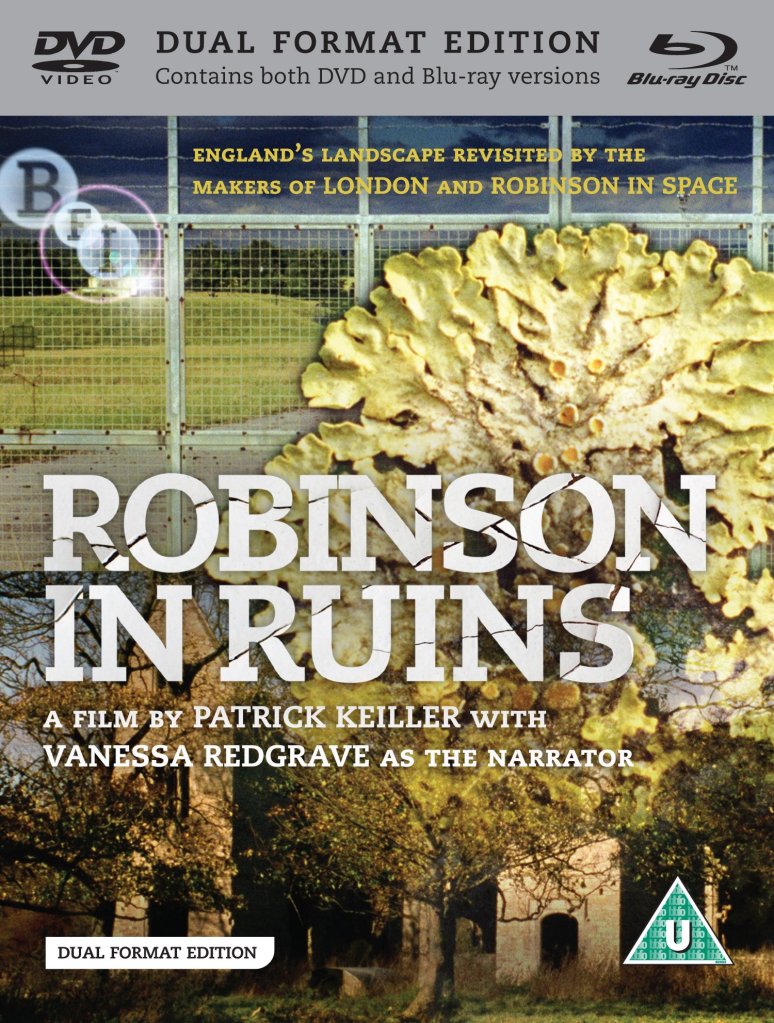
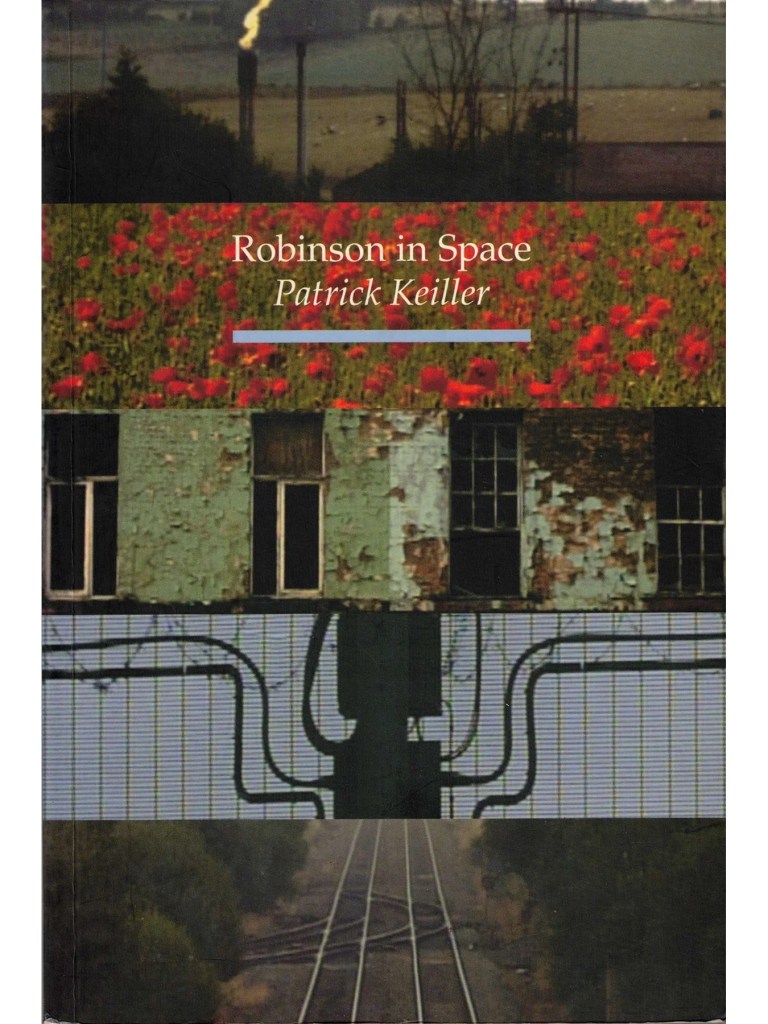
In this brief essay I will apply Timothy Corrigan’s analysis of the Essay Film, from his The Essay Film: from Montaigne, After Markeri, to an understanding of Patrick Keillers ‘Robinson Trilogy’, but most specifically the last in the series Robinson in Ruins (Keiller, 2010). We will briefly examine the research background to Keiller’s oeuvre and the critical response to Ruins, and examine whether we can take our understanding of the text further by utilizing Walter Benjamin’s allegorical methodological approach to reveal deeper meanings in Ruins.
Benjamin argued that allegory is a destructive strategy that can smash through the tyranny of ideal aesthetic symbols that place themselves totalising systems of power outside time. He called for ‘allegorical way of seeing’ as new means of looking at things. For Benjamin, as well as for Keiller in his filmography, views ruins as related to materiality, to the historical dimension of embodied existence, just as allegory is the intellectual process- ‘allegories are, in the realm of thoughts, what ruins are in the realm of things’. Benjamin’s interpretation of historical subjectivity contradicts and opposes a teleological history of continuous progress, often promoted by imperial Power: the ‘allegorical mode’ allows him to express ‘the experience of a world in fragments in which the passing of time means not progress but disintegration’- I want to argue in this essay for an allegorical reading of Keiller’s work, particularly Robinson in Ruins, and that it represents an allegorical critique of neo-liberalist global capitalist Power that presents it as an engine of chaos- in opposition to the totalising mythologies it projects of timelessness and as a system with no alternative- and foregrounds its fatal threat to civilization.
According to Corrigan the ‘essayistic experience of modern space’ presents a subjective self that must ‘travel directionless paths in search of homes that no longer exist and through landscapes strewn with colossal and other historical wreckage’- Keiller in his trilogy believes it’s the duty of this essay form to reveal patterns of power scarred into the geography of landscape, hidden often in historical strata, and to turn a searchlight in order to read the meaning that exists between these palimpsestic layers.
PREVIOUS RESEARCH
Daryl Martin has argued in his essay Translating Space that Keiller in Robinson in Ruins, although consistent with his preoccupation with landscape, overtly stresses the use of ‘metaphors of ruination’, and such ruination is evidence of a ‘politicized landscape’ that offer ‘alternative readings of past events’. And Brian Dillon in his Guardian article on Ruins argues that it entails a wider survey of the colonized spaces of the English landscape, and the paradox of an industrial countryside that is still culturally framed as pastoral and picturesque: in Ruins Keiller discloses the interconnectedness of the City, landscape and global financial capital through a linked series of associated images.
For Mark Fisher in his essay at the BFI insists the ‘traumatic event’ that ‘reverberates’ through Ruins is the financial crash of 2008. Fisher explains that the ‘ruins’ Robinson walks through are ‘partly the new ruins of neo liberal culture’, which is an ideology that has not yet ‘accepted its own demise’- and he declare that Robinson dares to hope that the financial collapse is more than ‘one of the crises by which capitalism periodically renews itself’. Yet both Jeff Malpas and Keith Jacobsx have identified the way Keiller’s work explores the entanglement of the structures of contemporary capital, and of resistance to those structures, within the material fabric of place and landscape. Indeed Keiller himself has spoken of his preoccupation with landscape in his research and work himself in various essays, including his various influences, and in particular to his Robinson in Ruins project ‘one of the aims of the project is to investigate the significance of the spatial qualities of landscape photography and cinematography’ and in his essay ‘Landscape and Cinematography’ he mentions that ‘after encountering a surrealist tradition in the UK and elsewhere, so that cinematography involved the pursuit of a transformation, radical or otherwise, of everyday reality’.
Much of Keiller’s approach can be identified, as previously mentioned in the introduction, to Benjamin’s notion of allegory, and I want to explore Keiller’s approach to landscape through the conceptual framework: how for example does the notion of allegory and ruins allow us to understand his films as representations of the destructive power of neo-liberal capitalism?
WHAT IS AN ESSAY FILM?
Timothy Corrigan has argued that the essay film stages film forms and that they reformulate existing filmic forms, such as documentary, the avant-garde, realism or narrative as a ‘dialogue of ideas’- and this is certainly an apposite description of Keiller’s films abundant with ideas and baroque cultural references. It is in this creative utilization of film forms through the media of the essay films stylistics that we see a disclosure of complex ideas put in play. And yet others, including Rascaroli, have said of the essay film as cinematic form: truly is the postmodern “matrix of all generic possibilities”. For example in all Keiller’s films ‘interlocutors patch together quotations’ that in many ways become ‘a kaleidoscope of inherited ideas, intellectual reflections and personal thoughts’ that are like pressures colliding to produce a lightning that illuminates new ways of seeing the landscape.
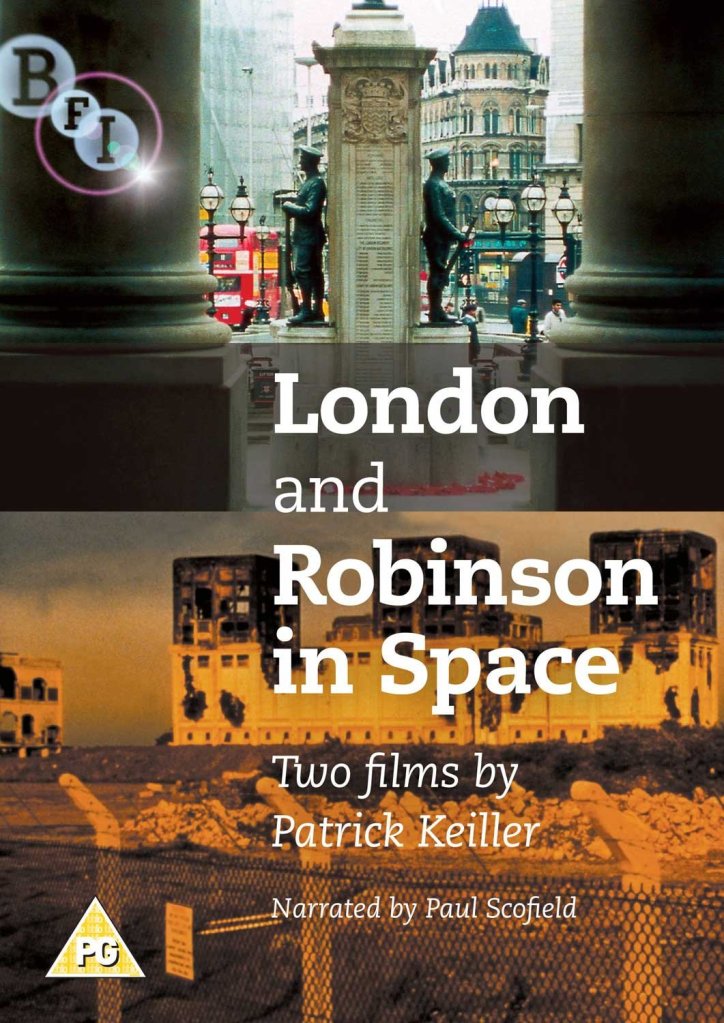
In Corrigan’s ‘The Essay Film’ he identifies three main types of essay film, the portrait, the diaristic or epistolary and the excursive-journey essay film, that Stella Bruzzi defines, specifically to Keiller’s London as the ‘reflexive journey documentary’. Corrigan assures us that the struggle to ‘communicate spaces’ becomes something of a rambling digression and discursive exploration that leads the traveller to dislocation or in his words, ‘an absent subject in foreign lands, an alien at home, a mind exiled from nature’. Through the creative process of essay film form- and this is what separates it from a basic travelogue- the very fact that it is a journey to explore fundamental problems or questions. For example Keiller has described his first film London, mediated through the character of Robinson, as an examination of the ‘Problem of London’ and the sequel Robinson in Space as a study of the ‘Problem of England’.
Corrigan has identified the notion of the ‘essayistic self’ or subject as one of the key drivers of the essay films narrative coherence, even where, according to Bruzzi, it ‘treats conventional notion of narrative ironically’. According to Corrigan, Robinson in Space, a film that is indeed an essayistic ‘excursion whose directions and geographies sequentially and simultaneously displace and dislocate each other’, as the film progresses we come to learn of Robinsons unravelling into a ‘state of total abjection and collapse’- as he traverses through these globalized spaces.
All the films in the trilogy are centred around the premise of the flaneur, another key Benjamin concept, taken from his fragmentary Arcade Project about Parisian shopping arcades. Like these, Keiller’s work is a collision of historical materialism, modernism and surrealism, politically militant and aesthetically defamiliarizing- but crucially, like the flaneur, concerns peripatetic exploration and the nomadic observations of the excursion. Through Keiller’s scholarly lens we come to recognise the romanticised English landscape of popular imagination as a colonized space to Anglo-American military imperialism, especially in Ruins, and the extensive militarisation of rural England: Keiller hints at a kind of enclosure, similar to the process of agricultural revolution of the 18th C, and in turn an enclosure of the militiarized spaces with privatized companies like Serco taking over such sites.
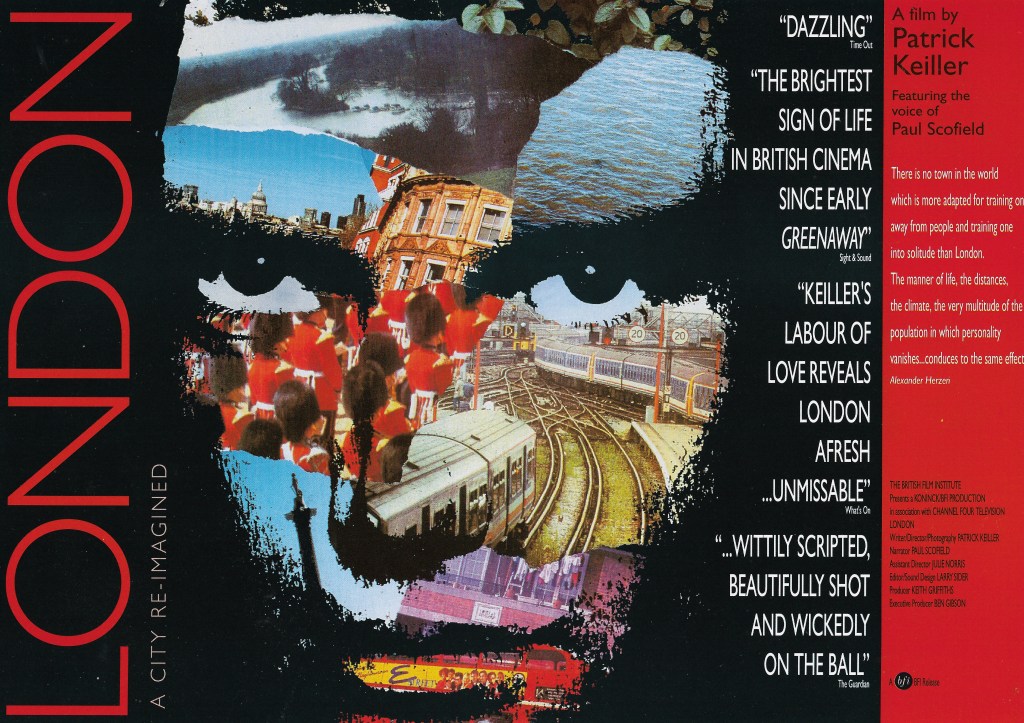
This allegory of ruins, of decay, degeneration and waste occurs as a common theme throughout the trilogy, even in London– a film preoccupied with the reflexive potential of film- Robinson assures us that most of the freight travelling down the Thames is waste destined for landfills in Essex. We learn at the start of Ruins, as the camera gazes fixedly at lichen growing around the letters of Newbury on a motorway sign, that the life of pre-mobile flexible labour force of industrial capitalism was made possible by the forced evictions of the enclosures.
The conclusion is that, according to Mark Fisher, in England ‘there is no landscape outside politics’, with huge swathes are networked installations of the military industrial complex. Keiller views capitalism as a process of displacement, evidenced in the ruination of the countryside; and one of the main themes of Ruins is the demystification of the markets as synonymous or identical with nature. Keiller quotes Edmund Burke, the father of British Conservatism and English market capitalism, and it is the allegories of ruination, of disintegration, alongside Robinson’s ‘biophilia’ and new ecological awareness, that reveals the mythology of such ideological assumptions.
Indeed Doreen Massey argues in her essay on Robinson in Ruins that Karl Polanyi maintained market capitalism ‘was not a natural development but, in fact, the product of state action’- he also argued that unregulated markets ‘destroy society and environment’. Keiller hints at this continual tension between the human and natural in opposition to the market and the State when he mentions how industrial capitalism was made possible by a mobile workforce, or market ‘flexible labour’ that had once been settled and reliant on local subsistence.
None of these cultural phenomenon emerged spontaneously from nature, but from State enforced legislation of the 1795 amendment to the settlement act of Parliament. Keiller’s biographical interest in Surrealism is evidenced in much of his shots throughout Ruins: for example we see a shot outside the gates of a local Power Station tightly framed, with the clouded Constable like sky overhead, and green shrubbery to the extreme left of the frame juxtaposed with the alienating long take of the Stations engineered uniformity.
This style of framing is much in evidence in the earlier London when we see the Citibank building at the City of London sprouting out from an English garden hedge, framed as though sprouting out of a rhododendrons bush. Still further Keiller intimates the more extreme imposition of Industrial neo-liberal culture on the ecological integrity of the Earth itself, when Robinson in Ruins, mentions ten leading climate scientists published a paper concluding that C02 level were too high to sustain civilization as we know it now.
Much like Vertov’s ‘cinema-eye’ in a Man with a Movie Camera (Vertov), Keiller ‘overcomes the limitations of subjective human vision’ by fusing it with the ‘larger objective truths of life’. Keiller himself has long been an admirer of Surrealism and its power to expand reality, and what Andre Bazin identifies this with the transfiguring power of the photographic process, a surrealist enlargement.
Bazin insists that for the surrealist the ‘logical distinction between what is imaginary and what is real tends to disappear’ and become an ‘hallucination that is also a fact’, which in turn intensifies the presence of the irrational. This is something we see on many occasions in Keiller’s films, through the lens of his keen surrealistic eye, and at times savage collision of incongruous images or surreal juxtapositions from London, when we see a luxury Cruise Liner coming down the Thames and then anchored next to a naval vessel- a juxtaposition of the UK cultural economy, the service leisure industry next to a symbol of the domestic military-industrial complex; or even the shot in Robinson in Ruins when Vanessa Redgrave’s voiceover describes the unravelling of the neo-liberal financial systemic crash of 2008 as a spider weaves a web in super-close-up: these are cine-documentary moments akin to surrealisms found-object.
In returning to Corrigan and his analysis of the essayistic excursive film he identifies how the subjective self begins to unravel, disintegrating, much like the landscape around them, and we witness a ‘breakdown of agency’, as the journey reaches its denouement. He insists this occurs due to the ‘excesses of their itineraries’ and becoming overwhelmed by the velocity of such Baudrillardian hyperreality of global spaces. Losing the capacity to stabilize themselves in such an uncertain world, their precarious condition, becomes defined by an inability to coordinate themselves within such a rapidly fluctuating world.
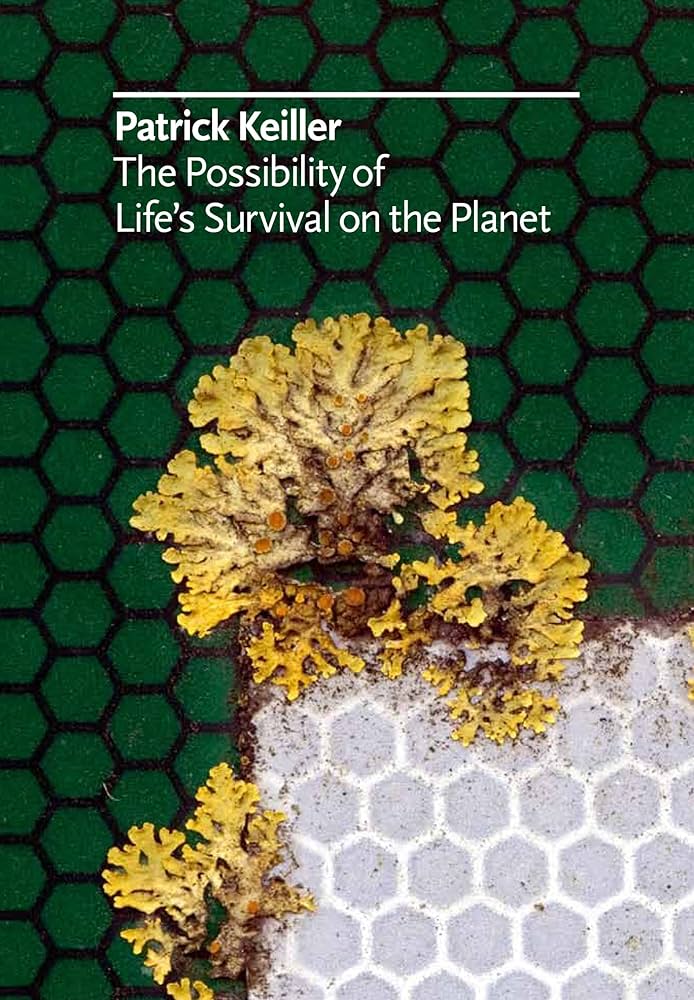
At the end of Ruins we learn that Robinsons penultimate piece of footage is of the ruinous caravan where his footage was found, soon to vanish, like much that has existed on the surface. There is no escape from globalized neo-liberal colonization of space, for there is ‘no landscape outside politics’, nor is anything resistant to the commercial control of capital. It is in the final shot of the milestone, lichen covered, like the abandoned caravan, dismantled, soon to vanish from the landscape, much like Robinson himself- and so we are left uncertain, just like a homeless Robinson, just like Keiller, like all of humanity, about the impossibility of dwelling in a lost uncertain world of neo-liberal precarity.
CONCLUSION
As we see in London in the trooping of colour sequence Power presents itself through a glamorous mythology of eternal symbols and simultaneously as a totalitarian suppression of its negative- the primary narrative of Power is an underrepresentation of the inevitable costs of the colonialism of global capital and its industrial processes, so that we never see the waste, degeneration and its ruin of the landscape and the earth. Hence we increasingly witness a moving of ‘problems’, or the negative side of ‘progress’, pushed out into the peripheries, onto the margins. Is the lichen captured by Robinsons camera on the old milestone on the Aberystwyth coach road a consequence of ecological disaster? For the lichen on the Newbury sign prospers in places rich with nitrogen pollution, as in busy roads or motorways- hence even the lichen is not separate from the ruinous totalitarianism of global capital and the industrial processes that generate its existence.
Even the idyll of the English pastoral landscape has been brutally scarred and colonized by such imperial Power. As Benjamin referred to in his concept of return, with the return of the same old stuff in which ‘the newest face of the world never alters, that this newest remains, in every respect, the same’- we witness throughout Robinson’s journey in Keiller’s trilogy is the return of the same old recurrent problems of terrorism, once the IRA, now Al Qaeda, or the financial crisis and ‘fear of redundancy’ of Black Wednesday in London to the credit crunch of 2008 in Ruins, increased homelessness, traffic, crime or the dismantling of the Welfare State- in this Robinson, and of course Keiller, is prophetic in his anticipations from the earlier films.
Benjamin refers to this ‘eternal return’ as the modern representation of hell, and as Robinson quotes Fredric Jameson at the beginning of Ruins, despite its ‘hellishness’ people can imagine no alternative. And yet ultimately the allegory of ruination, disintegration and collapse presented by Keiller in his Robinson Trilogy offers us a Benjaminian alternative that may offer humanity liberation from a system of power that threatens our very survival- ‘for Benjamin destruction is never an end in itself, it is only ever a process required to free history from accretions of tradition and mythology’.
 craigdevine88-dkjtq
Leave a comment