by CRAIG DEVINE
> “If a lion could speak, we would not understand him.”
> — Ludwig Wittgenstein
> “Un coup de dés jamais n’abolira le hasard.” / A throw of the dice will never abolish chance.
> — Stéphane Mallarmé
> “Pain and suffering are always inevitable for a large intelligence and a deep heart.”
> — Fyodor Dostoyevsky
This is a story written for all the children the city forgot to look for.
And for the people who looked anyway.
PART ONE: THE LION’S WORK
I.
The old man died badly in his opulent silk pyjamas. Not that there’s a good way to go when someone’s hands are wrapped around your trachea — but Vans Marr went out clawing at his herringbone Axminster rug like a dog for an out-of-reach bone. The gated Newton Mearns mansion was all marble and mahogany, the sort of polished bad taste common to the neo-ploutos: the darker and more sordid Marr’s criminal enterprise became, the flashier and more gilded was the carapace of conspicuous consumption. The champagne gold curtains were drawn against the morning light, leaving only the amber glow of a tacky yet expensive mirrored desk lamp to illuminate his final moments.
It was just before sunrise. More darkness than light. Down a long corridor of shadows, Marr’s feet were still, then fidgeting. Erratically, they convulsed into a tangled explosion — the final flames of life as feet and legs flailed in impotent struggle, a futile reflex. The tightening hands of a strangler gripped hard on the ligature around the lashing man’s neck. There was a desperate gurgling. A sobbing. A wretched yelp, muffled, as though the feeble cries were being made through cloth. The heavy effort of the strangler mingled promiscuously with the pitiful panting of the victim. There was a cruel intimacy at work.
The hands that killed Marr were steady. Professional. They belonged to someone who’d done this before, or who’d thought about it so many times that it was simply the dutiful execution of a job well done. On the left hand, catching the lamplight as it tightened, was a ring — heavy gold, the head of a lion with ruby eyes that seemed to watch as Vans Marr’s own eyes bulged and his face went from red to purple. Vans had tried to speak. The gaping mouth gulped for air like a fish out of water. But the hands only tightened. As the light turned, it became evident a cloth was over the dying man’s face. The twitching contours of a screeching face below the cloth. Below the cloth there was the mechanical gasping of the mouth. In. Out. In. Out. In. The feet stopped: the still, cold, fact of death. Silence. A silence that refutes all argument.
Whatever confession or curse or plea he’d been forming on his tongue had curled up and died with him, unspoken, unheard, locked forever in silence, as the red in his face turned to a kind of pale grey that resembled cold dead stone. The killer held on for a full minute after the body went slack. The hands of the strangler loosened, the vice-like grip relaxed, and the lion-headed gold ring caught the light one more time. The strangler untied the ligature from the dead man’s neck. Coiled it. Put it in his coat pocket with the care of a tradesman storing his tools. You can never be too careful with men like Vans Marr.
This was the end of an era for the city: the man who had ruled the Glasgow underworld for over forty years was dead. The killer stood, adjusted his coat, and walked over to the ensuite sink adjacent to Marr’s bedroom. He turned on the tap. Let the water run cold. Washed his hands with the methodical attention of a surgeon scrubbing out. A red spiral of blood swirled in the white porcelain sink. The water ran clear. He dried his hands on a towel that probably cost more than he earned in a week as a taxi driver. But money had never been the point. Rosco Holt stood in Vans Marr’s bathroom and looked at himself in the mirrored cabinet above the sink. The face that looked back was untroubled. Composed. A face that had decided something years ago and had been moving toward it with the primordial patience of deep geology ever since. Prison had given him that patience. The patience of granite. Tommy Breslin dying in the bunk below had given him something else entirely — not grief, not pity, but a map. A beautiful, intricate map of everything he needed to know.
And the most useful thing on that map was not the name of the man who killed Alice Noble. The most useful thing was the name of the man who loved her. Who’d never stopped looking for her. Who carried his grief so visibly, so nakedly, that anyone watching could read him like a ten quid note posted on a wall. Ziggy Noble. Rosco smiled at his reflection. It was a small smile. Private. It was so small only he could have seen it. Rosco opened up the drawer next to the unmade bed with its gold Egyptian cotton sheets and the Versace Sateen Weave covers- the open drawer revealed a black pistol: he lifted the Glock 48 and the magazine, filled with 9mm Luger calibre bullets with little brass case-heads, and slid it into the barrel until it smoothly snapped into place- the texture of the gun in his hand with its slide serrations gave it an excellent grip- he placed it in his inside coat pocket.
He walked back to the body. Knelt. Took an envelope from the pocket of the corpse — thick, cream-coloured premium paper, the kind that announced money even before you opened it. Inside: a handwritten ledger of payments made to three police officers, two sheriffs, and a man in the Scottish Parliament who’d been on Marr’s payroll since 2017. He folded it carefully and placed it not in his own pocket but in a plastic evidence bag he’d brought for the purpose. The bag went into the inside pocket of his coat.
Rosco then took from his other pocket a second item — a small, folded receipt from a petrol station on Eglinton Toll, timestamped yesterday morning. He pressed it between two fingers until it had picked up the faint impression of his own touch. Then he tucked it just barely visible under the edge of the Tapis Seti rug, perhaps a foot from Marr’s splayed hand. Far enough under that a careless search would miss it. Close enough that a thorough one would not.
The receipt was in Ziggy Noble’s name and paid on his debit card.
Rosco had been watching Ziggy for two months. Had learned where he drank, where he bought his petrol, where he did his shopping, what time he woke, when he had a shit. Had once, three weeks ago, slipped behind him at the petrol station self-service till and paid for his own cigarettes using Ziggy’s card — a tap-to-pay tap so swift Ziggy hadn’t even glanced up from his phone. The card had been in the tray on the counter. It was a calculated manoeuvre executed with devious delicacy. Ziggy had gone back for it a full thirty seconds later, confused, certain he’d imagined laying it down. He hadn’t imagined it. But Ziggy did have a long history of doubting the veracity of his own immediate senses.
Rosco stood, looked down at Vans Marr one last time. Then he spat on the dead body. The saliva landed on the silk pyjamas and sat there, glistening. He walked out of the mansion without looking back.
Behind him, Vans Marr lay sprawled across the faded silver of his Tapis Seti rug, the eyes still open, still staring at nothing. There was nothing but a heavy silence in the air. The kind of silence that sits coiled upon its own weight and presses down on everything like an invisible anaconda. It is a silence that reports itself as a fundamental shift in the world and will never shift back. Beneath the edge of the carpet, the petrol station receipt sat invisible, patient, waiting for its moment to be found. The rain started as the killer reached his car. It always seemed to rain in Glasgow. A city weeping for its sins, but it never washed them away- even the biggest storm cannot wash away the smallest of sin. And Rosco Holt had been cultivating his sins for a very long time.
—
II.
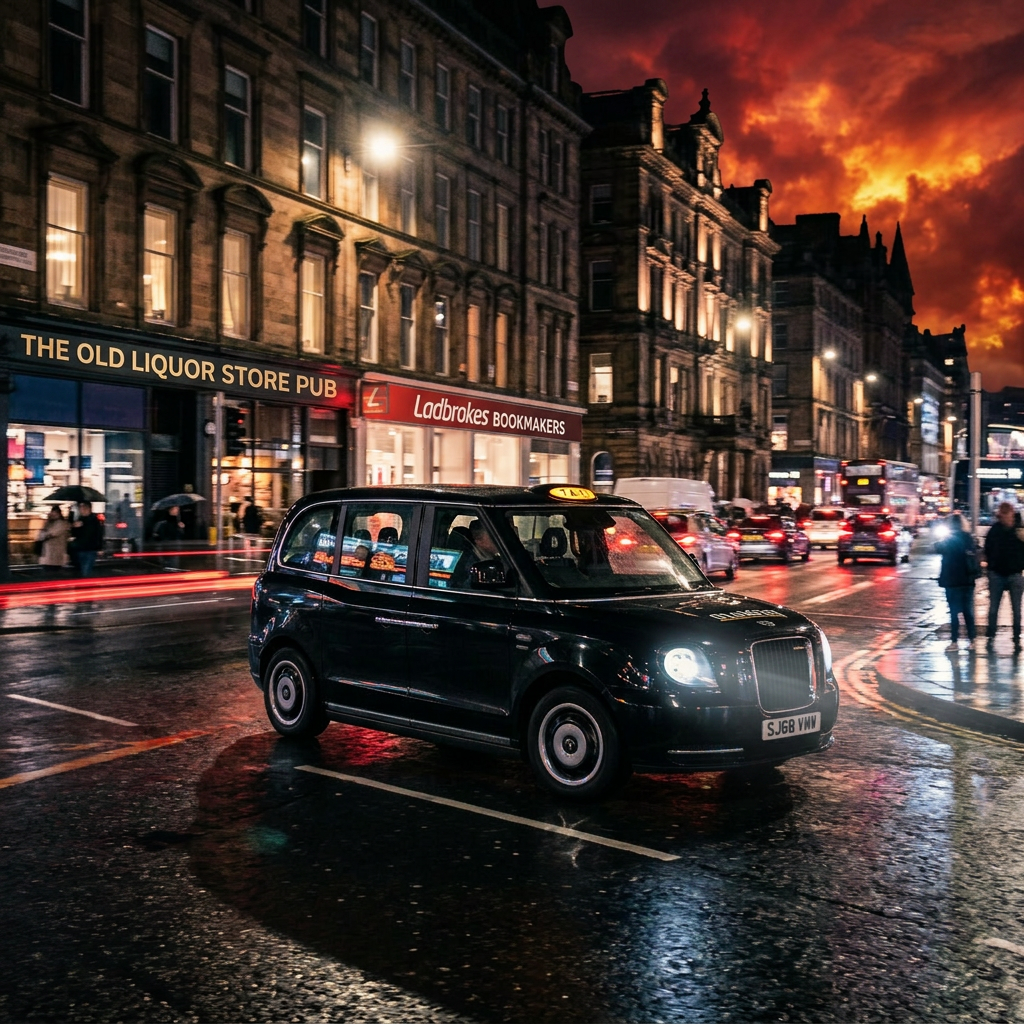
Rosco stared at the Glock sitting on his passenger seat as he waited for Ziggy Noble to come out of the bookies. This was three hours later at Elderslie Street, connecting Argyle Street to the south and Sauchiehall Street to the north, as they both, intermittently, turned residential as they made their way to the West End. He sat aggressively tapping an irregular rhythm against the worn leather of the steering wheel. The sky was the colour of arsenic. Dimming. Smoke black. Encrusted in pewter grey. The taxi — the long black body of a Peugeot 508 — in the dwindling light of the morning resembled a hearse. Rosco was parked at Dover Street looking across to a grotty little row of dilapidated shopfronts, one of them a betting shop next to an old boozer called Orwell’s.
Inside the car, Rosco watched the street for Ziggy and like the best of predators who have become masters of time, he had become as patient as death itself: They know that waiting is not passive. Waiting is like a form of violence held in suspension. They learn the patterns of their prey. The routines that reveal vulnerabilities. The way a man moves through the world when he thinks no one’s paying attention. The way he stands. The way he walks. The way he looks over his shoulder without knowing why. The way grief makes a person predictable. The way grief makes a person useful.
Rosco had a plan. The plan was beautiful in its simplicity. It required two things: a man with motive, and a man with opportunity. Rosco would provide the opportunity. Ziggy Noble, poor broken Ziggy Noble with his dead sister, his whisky, his demons and his eight years of festering rage, would provide the motive. The motive would be confirmed by every person who’d ever known him. His friend Danny, who worried about his mental state. His GP, who’d prescribed him antidepressants three times. The barmaid at the Deoch An Dorus pub on Dumbarton Road who’d heard him say, on three separate occasions and with increasing violence of expression, that he would kill the men responsible for his sister’s death if he ever found out who they were. All Rosco had to do was tell him. It was as simple as releasing a rudimentary trigger. Tell him. Fill in the blanks. Supply the names, the addresses, the righteous outrage. Aim him like a gun and let him fire. And then step back. Step well back.
It was a matter of psychology, really. Not philosophy — though Rosco would bring that in, layer it over everything, give Ziggy something to hold onto while the frame closed around him. Rosco had read enough in prison to know that a man in pain will reach for any hand extended to him. Give him Wittgenstein. Give him Nietzsche. Give him any old bullshit to cling onto. Give him the sense that someone out there spoke his private language of suffering. Trust was just a story told in the right accent and with the right tone.
A few derelict-looking regulars had gathered outside the pub, rolling their fags between some heated debate. Their voices carried across the street, but the words were lost. Just the rhythm of argument. The cadence of men with nothing to do and all day to do it. From inside the taxi, it sounded like a savage static out of tune from the hiss of radio mouths- Rosco opened his window to hear clearer: going by the echo of the words down the street they were discussing the breaking news of Vans Marr’s murder.
The rain had settled into that fine Scottish mist, a dour drizzle that isn’t quite rain but soaks you through all the same. It turned the city bucket grey — the buildings, the streets, the people fossilised in its steely bleakness. Everything vampirised in despair.
The taxi’s wipers scraped across the windscreen in a hypnotic rhythm. Back and forth. Back and forth. Rosco’s eyes were fixed on the bookmaker’s door.
Then his man came out. Ziggy Noble. He stood there in the mist, collar turned up against the gloomy weather, looking like every other poor bastard in Glasgow trying to make it through another day. Today was the anniversary of his sister Alice’s murder — or disappearance, as the official record still called it. The body had never been found. The case had gone cold. But Rosco knew things the official record didn’t know. Tommy Breslin had told him everything from the bunk below, the cancer eating him hollow while his words filled the air of their shared cell like gas filling a room.
Rosco knew where Alice Noble was buried. Had known for eighteen months. Had chosen to do nothing with that knowledge until the time was right. Now the time was right, and ripe for exploitation. He could see it in the way Ziggy held himself. The way his shoulders curved inward like he was trying to protect something that had already been taken. The way his eyes scanned the street without really seeing it. The anniversary pressed on him like the excess weight of a pilgrim stone tied to a man who had lost all faith.
Ziggy was a ghost haunting his own life. And ghosts, Rosco thought, are easy to haunt in return. The radio crackled. Some patter about the weather. As if anyone in Glasgow needed telling it was pishing doon outside. Rosco ignored it. His hand — the one with the ring — drummed against the wheel. The lion’s ruby eyes caught the grey light filtering through the windscreen.
Ziggy started walking east, down Kent Street, hands shoved deep in his pockets, head down, back towards the city centre. His gait was slow. Fatigued. Like a man wading through water. Like a man who’d forgotten why he was walking but couldn’t remember how to stop. It was as if some form of zombification had overtaken the poor benighted bastard, thought Rosco.
Rosco let him get half a block before starting the taxi, pulling out into traffic with the casual ease of someone who’d driven these streets for years. Which he had. Before that, he’d walked them as an enforcer for Vans Marr, collecting debts and breaking bones and building the sort of reputation that made even the toughest of men shake and rattle at the mention of his name. That was the old Rosco Holt. That kind of work thad eventually put him in Barlinnie for seven years. Seven years in which everything had clarified. In which the plan had taken shape with the slow inevitability of a crystal forming in solution.
He kept three or four car lengths between himself and Ziggy. Professional distance. Not too close. Not too far. The perfect interval for a predator trailing prey that hasn’t yet understood it is being hunted. Rosco followed him to the edge of Granville Street and drove parallel as Ziggy walked along the side of the Mitchell Library toward Sauchiehall Street. The library loomed above them, its statues standing sentinel over the city. Like everyone else in Glasgow they had seen everything and said nothing. Rosco continued to watch Ziggy in the mirror. Watched the way the rain darkened his jacket. Watched the way his breath came out in small clouds of steam. Watched the way he moved through the world like he was already dead and just hadn’t gotten around to lying down in a hole in the sod yet.
Good, Rosco thought. Good. The broken ones are always easier. He looked down at the Glock on the passenger seat. He began to pull the taxi over toward Ziggy, and then he opened the glove compartment and put the pistol inside. Rosco stopped the taxi and cranked the window a fraction. He let Ziggy get to the corner of Sauchiehall Street. Then he waited for the man to look for a taxi. Which he did, inevitably. Because they always do, in the rain, in Glasgow, on the worst days of their lives. They reach for the small mercies available to them: a warm cab, a stranger’s indifference, the illusion of forward motion when everything inside them has stopped. Rosco pulled up to the curb. Leaned across and rolled down the passenger window.
“Need a lift, pal?”
III
“Aye,” Ziggy replied, almost absently. His voice was rough, like he hadn’t used it much lately. Like he’d forgotten how. Like words were something that happened to other people. “Aye, cheers.” He climbed in, bringing the smell of rain and whisky and something else, like the vapor of desperation, if desperation had a smell. There was a long uncomfortable pause as though Ziggy didn’t know why he was sitting in the taxicab. Then he gave an address in the West End.
‘Eldon Street…driver’
Rosco nodded, pulling back into traffic, and said nothing. Let the silence do its work. Silence was a tool as much as speech. Rosco had learned that in prison — from the interrogation of solitude, from the long hours when Tommy Breslin had slept and Rosco had lain awake in the dark thinking about what needed to be done and how to do it and in what order.
For a while, neither man spoke.
‘The names Rosco- Rosco Holt’
The taxi’s heater rattled and wheezed, pushing out air that was barely warmer than the rain outside. The wipers kept up their rhythm. Back and forth. Back and forth. Rosco watched Ziggy in the rearview mirror. The man sat hunched forward, staring at his hands like they belonged to someone else. Like he was trying to remember what they were for. Rosco waited for a reply and wondered if maybe this poor sucker was too far gone.
‘I’m Ziggy- Ziggy Noble’
“Miserable day,” Rosco replied to keep the conversation going.
Ziggy looked up, met his eyes in the mirror. For a moment, something passed between them. Rosco had practised this look. The recognition look. The shared-suffering look. The I-have-seen-darkness-too look. He wore it the way a skilled actor wears an emotion: felt enough to be convincing, controlled enough to be useful.
‘They’re all miserable,’ Ziggy said. ‘I’m just honest about it.’
Rosco let his face shift — something almost resembling a smile, suppressed, like a man who’d forgotten how to be amused and was remembering by degrees. ‘fair enuff big yin’ he replied.
Then he turned left when he should have gone straight, taking them away from the West End and toward the south-side of the city. Not dramatically. Not sharply. Just a gentle drift in the wrong direction, made to seem like a traffic consideration, a familiarity with the backstreets. But Ziggy didn’t notice. He was back to staring at his fingers, like a child too preoccupied with the shattered debris of a broken toy in his hands. Ziggy blew vigorously into them and rubbed them together as though to take the cold out of them. But the cold wasn’t in his hands.
The lion-headed ring caught the light as Rosco shifted gears. “When I was in prison,” Rosco said, beginning the performance in earnest, “I got to reading.” He watched Ziggy’s face in the mirror. Watched for the small signs: the slight elevation of the eyebrows, the fractional turn of the head that meant engagement, the revealing micro-gestures. There it was. The hook going in.
“Someone gave me this Mike Tyson autobiography: he said he read Voltaire, Tolstoy, Shakespeare and Dostoyevsky when he was in prison.” A pause. A slight slumping of the shoulders, as though the memory cost him something. “And I thought if he can read that sort of stuff, so can I.”
Ziggy laughed. It was a harsh sound. Dismissive. “You believed he actually read the likes of Tolstoy? Mike Tyson?” “I don’t mean to mock,” Ziggy added quickly, catching something in the taxi driver’s expression. “I just find it hard to believe a moron like Tyson read those kind of books.”
“Aye, well.” Rosco let the forlornness land. Let it sit there. “It motivated me to go to the prison library anyway.”
“Good for you.”
“Rosco,” Rosco said. “The name’s Rosco.”
‘Yeah I know- learning is a good thing my friend- I should know I’ve spent a lifetime at it’. And there it was. First names. The scaffold of intimacy going up, beam by beam.
Rosco steered the car through the wide boulevards and monumental villas of Dumbreck, past Bellahouston park up Nithsdale Road toward Pollokshields. They stopped at a set of traffic lights at Darnley Street. The windows steamy, Rosco wiped his to see a group of Asian teenagers huddled in a doorway. They passed a bottle of Buckfast between them like a bad secret. A cyclist whizzed through the red light in the direction of Pollokshaws Road. An old man wearing a shell suit and a pair of Jesus sandals was holding onto an empty shopping trolley, he was talking to himself or to ghosts, as he waited for the green man to flash his approval.
“Have you ever heard of Ludwig Wittgenstein?” Rosco asked. He watched Ziggy’s eyebrows go up. “Sure. Did they have the Blue and Brown books in the prison? Some universities don’t even have those books.”
He’d anticipated this. Ziggy Noble had studied philosophy at Glasgow University before dropping out in his second year and taking up Literature in his third year. The grief of Alice’s disappearance had made sustained concentration impossible. Rosco had found that out from a social media deep-dive, from conversations overheard in Ziggy’s local, from piecing together a portrait with the patience of a man who had nothing but time and the will to use it correctly.
“Naw, just the Tractatus and the Philosophical Investigations,” Rosco said. “But that was enough.” A pause — measured, careful. “He said something like, ‘if a lion could speak, we wouldn’t understand what he is saying.’”
“That’s why you have the ring?”
“Aye. I am the lion. No one can know what I have experienced.”
He made his voice firm on those last words. Certain. A man who’d found his philosophy and was holding it like a shield. He watched Ziggy’s face soften just fractionally — the micro-expression of someone who’d found another person speaking their private language.
And the thing was, it was almost true. The ring had reminded him of the Wittgenstein quote. He had thought of himself as a lion. The difference was that Rosco’s interpretation was not the melancholy lion of isolated experience — it was the apex predator lion, the one who cannot be understood because he has no need to be understood, who operates in a dimension of pure will that ordinary men cannot access.
The conversation about philosophy went on. Rosco let Ziggy lead, let him show his intelligence, let him feel the pleasure of being listened to by someone who could follow where he went. There was the famous Mallarmé quote. The dice. The abolition of chance. Rosco fed the conversation what it needed and watched it grow.
All the while, the taxi was heading in the wrong direction. And then, with the gentleness of a surgeon making the first incision, Rosco said: “Thought you might want to stop at the graveyard first.”
Ziggy went very still. “How did you—”
“Saw the flowers in your bag.”
A lie. But a good one. The flowers Ziggy had bought at a petrol station — the same petrol station whose receipt now sat under the edge of a rug in Vans Marr’s mansion. Rosco had seen him buy them this morning. Had been watching.
And so the graveyard visit was accomplished. And the foundations of trust were laid. And Ziggy Noble sat in the back of the taxi and felt, for the first time in a very long time, that he was not entirely alone in the world.
Which was exactly what Rosco needed him to feel.
The trap had teeth now. All it required was patience and the proper application of jaw pressure. The name of Skelton Dundas would come later. The visit to the flat in Maryhill would come later. The gun would come later.
First, there had to be the news on the radio.
Rosco checked his watch. Right on time, the news bulletin he’d been anticipating — the one that would have run regardless of his plan, because Vans Marr’s body had been discovered three hours ago — broke across the airwaves.
He reached for the dial. Turned it up slightly. Just slightly. As though adjusting for road noise.
And waited for Ziggy to hear his sister’s murderer named him as a murder victim. The trap snapped shut.
V.
“The world is all that is the case.”
> — Wittgenstein, Tractatus Logico-Philosophicus, 1.
> “Man is the only creature who refuses to be what he is.”
> — Albert Camus
> “Pain and suffering are always inevitable for a large intelligence and a deep heart. The really great men must, I think, have great sadness on earth.”
> — Fyodor Dostoyevsky, Crime and Punishment
> “All that is needed for evil to flourish is for good men to do nothing.”
> — attributed
—
The radio report ran for four minutes and twenty seconds. Rosco had timed it in his head — he’d heard the same bulletin on the hour three times already this morning while driving the empty streets, while waiting, while reviewing the plan for the hundredth time with the methodical care of a man who cannot afford to be wrong.
He watched Ziggy’s face in the mirror as the words landed. Vans Marr. Sixty-six. Newton Mearns. Strangled. Watched the sequence of recognition, confusion, and then something else — something that started slow and built, like a wave still out at sea that you can see coming even before you can hear it.
“Turn it up,” Ziggy said. His voice was sharp. Animated. Turn it up. Rosco reached for the dial. Let the voice grow louder.
NEWS: “—Marr was a controversial figure in Glasgow’s underworld for over four decades. While never convicted of any serious crimes, he was widely believed to be involved in various illegal enterprises including drug trafficking, money laundering, serious organised crime and known colloquially as the Godfather of—”
Ziggy was forward in his seat now, hands gripping the back of the passenger headrest. Alive, for the first time since he’d gotten in the car. The grief had transmuted into something with velocity. When the report ended, Rosco let the silence breathe for a moment before he spoke.
“Vans Marr,” Ziggy said to himself. “Fucking hell. Vans Marr.”
“Aye.”
“Someone mad cunt strangled him.”
“Aye.”
“In his hoose anaw.”
“Aye- ah-know”
Ziggy was quiet. Then: “Why were you really in prison, Rosco?”
The question came faster than expected. Good. That meant Ziggy’s instincts were working — were alive — which was essential to the plan. A man who suspected nothing would be useless to him. A man who suspected something but had it redirected — that was the instrument he needed. Suspicion in the service of the wrong conclusion. The taxi slowed. Stopped at a red light. The rain hammered on the roof.
“I told you. Assault.”
“But that’s not all, is it?”
They had stopped at a junction in Victoria Road. The light turned green. Rosco didn’t move. A car behind them honked. Then another. He put the taxi in gear and drove on. Let the pause work. Let Ziggy read the hesitation as reluctance, as shame, as the burden of a man who’d done things he couldn’t take back.
“No,” he said finally. “That’s not all.”
“Tell me.”
“Why do you want to know?”
“Because—” Ziggy stopped. Tried to find the words. “Because I feel like you brought me here for a reason. To the graveyard. Because you knew about Alice. Because you’re not taking me where I asked to go. Because something’s happening and I don’t understand what it is but I know it’s important.”
He knows something is happening. But he doesn’t know what. That was the gap between them — the gap that looked like shared understanding and was actually a chasm. Ziggy was gazing across it and seeing a reflection of himself. He was seeing a man who had suffered. A man who understood. A man who had been beaten down by the same city, the same violence, the same systemic corruption that had taken Alice from him.
What he was actually seeing was a man who had used all of that as raw material. Who had built something from the ruins of it — something cold and purposeful and entirely unencumbered by the moral hesitations that hamstrung the Ziggy Nobles of the world.
“I shared a cell with a man named Tommy Breslin,” Rosco said.
This was where the real performance began. Every word of what followed was true — Tommy had been his cellmate, Tommy had worked for Marr, Tommy had known the books, Tommy had confessed everything in those final months while the cancer ate through him like acid through iron. All of that was true. What Rosco omitted was his own role. What Rosco constructed, in the careful architecture of his omissions, was the portrait of a man who had been told about the trafficking ring — not a man who had run part of it. A man who had been revolted — not a man who had, for three years prior to his arrest, served as Marr’s principal enforcer on the supply side of that same operation. A man who had collected children from the streets of Glasgow’s poorest estates and delivered them, efficiently and without feeling, to the men who paid Vans Marr for the privilege.
Rosco had not been a bookkeeper. He had been the mechanism. He had been the hand that orchestrated things, like the puppet master with his strings: never touching, never contaminating anything with his fingerprints, but communicating to others, the ordinary fodder of Marr’s criminal network, what he wanted done. Tommy Breslin had known this. Had known everything. Had told Rosco, in their shared cell, not as a dying man’s confession but as a dying man’s veiled threat — I know what you did. I know where the bodies are. I know your name is in the ledgers alongside everyone else’s.
It had been a miscalculation on Tommy’s part, a foolish assumption that Rosco, like him, wanted absolution, wanted to confess, wanted to be understood. Rosco had listened carefully to everything Tommy told him. Had extracted every useful piece of information — the names, the locations, the buried evidence. And then had waited. Had kept his silence. Had let Tommy die without ever giving him the absolution he’d been reaching for. Because absolution was not Rosco’s gift to give. And because Tommy Breslin’s information was worth infinitely more than Tommy Breslin’s peace of mind.
All of this was absent from the story Rosco told Ziggy Noble in the back of the taxi. In the story Rosco told, Tommy was simply a dying man with secrets. The secrets were about the ring. The ring had taken Alice. The man responsible — operationally responsible, the man who had done the actual taking, the actual killing, the actual burying — was named Skelton Dundas- and this Dundas was living in Maryhill.
All of that was true. Dundas had done those things. Had done them because Rosco had directed him to. Had buried Alice Noble in the clearing in the woods near Castlemilk on Rosco’s explicit instruction, because Alice had been eight years old and was becoming inconvenient, and because Marr had authorised disposal, and because Rosco had passed the authorisation to Dundas the way a manager passes a task to a subordinate.
What remained of Rosco’s conscience — and there was something there, some vestigial organ, atrophied but not entirely absent — had noted this moment years later, in the quiet of a prison bunk, as the first and only time he had felt anything that resembled shame. Not for the act itself. For the waste of it. For the casual way it had been done. But shame, like most emotions, was not a permanent address for Rosco. Just a passing weather pattern.
In the back of the taxi, Ziggy Noble was listening to every word with his whole body, leaning forward, hands white on the seat back, face transfixed with the expression of a man who is receiving the worst and most necessary truth of his life.
“He told me about a girl,” Rosco continued. “Eight years old. Taken from Castlemilk. Never found. Never solved.” A pause. The careful modulation of a voice carrying grief. “Her name was Alice Noble.” The world stopped. Or Ziggy’s world stopped. Rosco’s kept moving, carefully, inside the stillness.
He watched Ziggy’s face in the mirror. Watched the moment of total dissolution — the eight years of held-together collapsing all at once, the dam breaking, the grief that had been held in a matrix of structural suspension finally losing its integrity. Watched the man weep with the helpless totality of someone who had no more reserves.
Rosco pulled the taxi over. Stopped on a side street. Let Ziggy cry.
He was good at waiting. He had always been good at waiting.
After a long time, Ziggy’s sobs subsided. He wiped his face. Looked up at Rosco in the mirror. His eyes were red. Raw. Destroyed. The eyes of a man who had been given the truth and found it to be exactly as terrible as he’d always feared.
“How do you know?” His voice was barely a whisper. “How do you know it was her?”
Rosco provided the details Tommy had given him. Provided them with the precision of testimony — dates, places, descriptions. All of it real. All of it accurate. All of it carefully deployed to establish Rosco’s credibility as a man sharing hard-won truth.
“Who?” Ziggy’s voice had changed now. Gone cold. Gone flat. The grief collapsing into something denser. “Who was involved?”
“A man named Skelton Dundas. He’s living in Maryhill now. Flat above a chippy on Maryhill Road.”
“You know where he is.”
“I know everything about him. Where he lives. Where he drinks. Where he goes on Thursdays to collect his benefits. I’ve been watching him for two months.”
This was true. Rosco had been watching Dundas for two months. Watching him with the concentrated attention of a man who needed to know exactly where Dundas would be and when, because Dundas had knowledge that could destroy Rosco, and because destroying Ziggy required, first, the destruction of Dundas — but in a way that left no fingerprints pointing upward. Only downward. Only toward a grieving brother with motive and history and a fragile mental state that could be leveraged into something that looked, from the outside, like exactly the kind of breakdown that ended in violence.
“Why?” Ziggy asked.
Rosco met his eyes in the mirror. The lion-headed ring caught the light.
“Because I killed Vans Marr this morning,” he said. “And now I’m going to help you kill the man who murdered your sister.”
He watched the words hit. Watched Ziggy absorb them. Watched the calculation happening behind those red-rimmed eyes — the weighing of belief against disbelief, of trust against suspicion, of grief against sanity.
And then Ziggy Noble said nothing. Because there was nothing adequate to say.
‘Where are we?’ Ziggy asked, suddenly realising he wasn’t anywhere near where he needed or wanted to be.
‘This is Regent Park Square.’
‘Why are we here?’
 craigdevine88-dkjtq
Leave a comment